
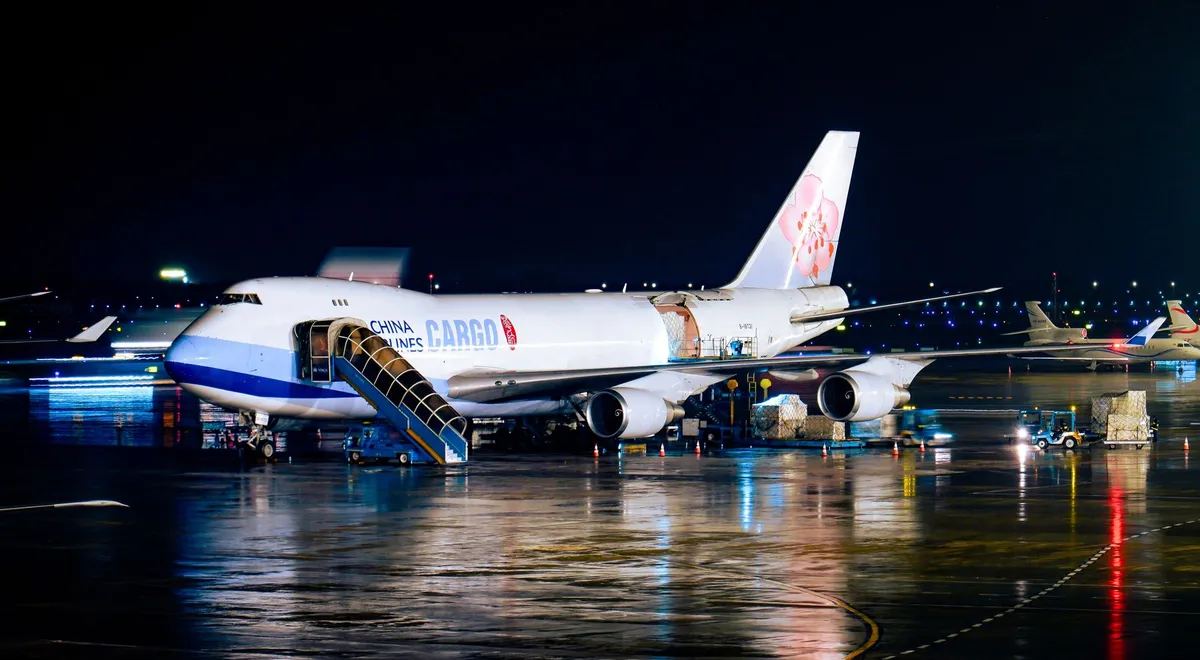
Air freight from China moves your cargo in days, not weeks — but the price tag makes many importers flinch before they run the numbers. The real question is never “Is air shipping expensive?” It is: What does the delay cost you compared to what the flight costs?
This guide breaks down door to door air shipping from China with real 2026 numbers: transit times, per-kilogram rates, the hidden costs most quotes ignore, and the exact scenarios where air wins on total economics — not just speed.
How Door to Door Air Shipping Actually Works
Door to door air shipping means your freight forwarder handles the entire chain: pickup at the factory in China, export customs, the flight itself, import clearance at destination, duty and tax payment, and final delivery to your address. Under DDP terms, every one of those steps is included in a single quote — you pay once and the cargo simply arrives.
Typical routing has three legs:
- Origin handling (1–2 days): factory pickup, consolidation, export declaration at airports like Guangzhou (CAN), Shenzhen (SZX), or Shanghai (PVG).
- Main carriage (1–3 days): commercial passenger belly freight, freighter service, or express carrier network.
- Destination handling (1–4 days): import clearance, duty payment, deconsolidation, and last-mile delivery.
The air transit itself is the fast part. What separates a 5-day delivery from a 12-day one is almost always ground handling and customs efficiency — which is why experienced importers route through forwarders with their own bonded channels rather than booking flights directly.
Speed Comparison: Air vs Sea in Real 2026 Transit Times
Here is what door to door timelines look like in practice from major Chinese export hubs:
| Route | Air DDP (door to door) | Sea DDP (door to door) | Time saved |
|---|---|---|---|
| China → USA West Coast | 5–8 days | 22–30 days | ~3 weeks |
| China → USA East Coast | 6–10 days | 28–38 days | ~4 weeks |
| China → UK / Western Europe | 4–7 days | 24–32 days | ~3 weeks |
| China → Middle East (UAE) | 3–5 days | 18–25 days | ~2.5 weeks |
| China → Australia | 4–6 days | 20–28 days | ~3 weeks |
Express DDP services — think DDP via express networks with dedicated charters on peak lanes — can compress China → major Western markets to 3–5 days door to door, at a further premium of roughly 30–50% over standard air DDP.
Cost Comparison: The Numbers That Matter
Air freight is priced on chargeable weight (the greater of actual vs volumetric weight, using a 1:6,000 cm³ divisor). As of Q3 2026, indicative door to door DDP rates from China:
- Standard air DDP: USD 4.5–7.5 per kg to the US and Europe
- Express DDP (3–5 day): USD 6.5–10 per kg
- Sea DDP (LCL): USD 1.2–2.5 per kg equivalent
At face value, air costs 4–6x more per kilogram. But per-kilo comparison hides the real economics. Air freight charges for speed and density; sea freight charges for cube. A pallet of phone cases ships cheap by sea. A carton of urgently needed spare parts or a high-value electronics sample often costs less in total by air once you add inventory carrying cost, stockout risk, and missed sales.
For a detailed per-kilogram breakdown across all modes, see our DDP shipping cost breakdown. To model your specific shipment, the DDP shipping cost calculator handles chargeable weight, fuel surcharges, and duty estimates in one pass.
Hidden Costs That Distort the Comparison
Three costs routinely get left out of naive air-vs-sea math:
1. Inventory carrying cost
Capital tied up in a 30-day ocean transit is capital not available elsewhere. At a 15% annual cost of capital, one month of transit on USD 50,000 of goods adds roughly USD 625 in financing cost — before warehousing.
2. Stockout and penalty costs
If air freight prevents a 10-day stockout on a product generating USD 2,000/day in margin, the USD 3,000 air premium is the cheapest money you will ever spend. This is why Amazon sellers front-loading inventory before Q4 so often choose air for the final replenishment wave.
3. Volumetric weight surprises
Air’s 1:6,000 divisor punishes bulky, light cargo. A 20 kg carton measuring 60×50×40 cm has a volumetric weight of 20 kg — fine. But a 10 kg carton at 60×50×60 cm bills as 30 kg. Bulky goods with low value density almost always belong on the water. Our guide to cheapest door-to-door shipping from China covers the consolidation tricks that blunt this penalty.
When Air DDP Wins — and When It Doesn’t
Choose air DDP when:
- The goods are high value density (electronics, fashion samples, auto parts, medical devices) where freight is a small % of unit value
- You face a hard deadline: product launch, seasonal window, production line stoppage
- Cash flow favors fast inventory turns over lowest unit freight cost
- Order size is under ~300–500 kg, where air’s minimum-charge economics still work
Choose sea DDP when:
- Cargo is bulky, heavy, or low value density (furniture, building materials, plush goods)
- You can plan 4–6 weeks ahead with reliable demand forecasts
- Order volume fills even part of a container, unlocking per-unit rates air cannot touch
Many established importers run a hybrid: sea freight for baseline inventory, air for replenishment and new-product testing. The complete door-to-door shipping guide maps out how to structure both flows under one forwarder relationship.
How to Get an Accurate Air DDP Quote
A reliable air DDP quote should itemize: pickup fee, export clearance, air freight (chargeable weight), fuel surcharge, security fee, destination clearance, duties and taxes, and delivery. Vague “all-in” numbers without a weight breakdown are a red flag — they usually hide a volumetric-weight repricing surprise at origin.
At DDPShipping, we quote air DDP door to door with chargeable weight confirmed before pickup, duties prepaid under DDP, and no destination handling surprises. If you are weighing air against sea for an upcoming shipment, send us the carton dimensions and we will run the speed-vs-cost math both ways — usually within a few hours.