
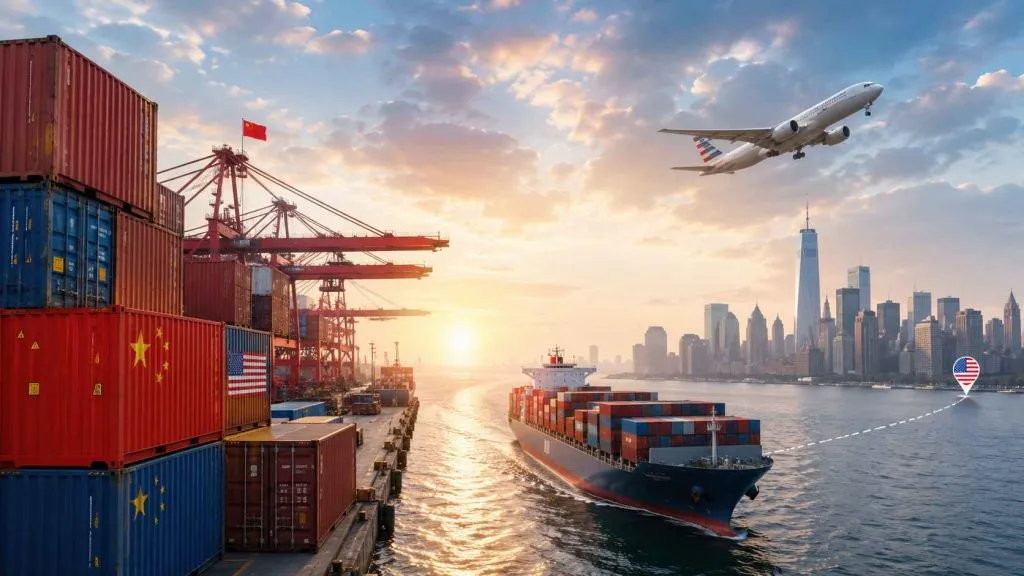
The DDP shipping cost from China to the USA is not one number. It is a stack: factory pickup, export clearance, ocean or air freight, terminal handling, customs entry, duty, and the last mile. In November 2026 the duty layer is usually the largest of them, which is why two quotes for the same three pallets can sit $1,760 apart and both be honest.
One forwarder assumed a 25% Section 301 code, the other 7.5%. One included the residential liftgate, the other priced it separately. One clears under its own bond, the other under yours. None of that appears in a per-kilogram figure, and all of it appears on the invoice.
What follows is the rate picture for this quarter, the full 2026 duty stack, and four shipments costed line by line, so you can see where the money goes before you book.
How much does DDP shipping from China to the USA cost?
Short answer: $150–210 per CBM for dense FCL cargo, $300–420 per CBM for LCL under 10 CBM, and $7–12 per kg by air. All figures are all-in, door to door, duty included.
| Cargo profile | Typical all-in DDP range | What drives it |
|---|---|---|
| FCL, dense cargo, 40ft | $150–210 per CBM | Ocean rate, duty rate |
| LCL under 10 CBM, 120–200 kg/CBM | $300–420 per CBM | CFS charges, minimums, last mile |
| LCL by weight, same density | $5.50–9.50 per kg | Duty often exceeds freight |
| Air freight, general cargo | $7–12 per kg | Peak-season air rate, handling |
| Express courier | $10–16 per kg | Carrier tariff, no consolidation |
Two caveats before you use those bands. A price per kilogram means nothing without the density, the HTS code and the delivery ZIP, because a 36.5% duty category costs more per kilogram than a duty-free one at the same density. And the bands move: trans-Pacific spot rates fell 3% in the last week of October after peaking near $8,400 per FEU in early October.
Most importers eventually want a number per unit rather than per kilogram. That calculation is goods value plus every line in this article, divided by sellable units. The sections below supply the lines.
One qualification before the numbers: our minimum shipment is 45 kg. Below that we do not quote, and the parcel arithmetic in this guide does not apply.
DDP shipping cost per kg, per CBM and per container
The unit a forwarder quotes in tells you what is and is not included.
| Mode | Unit price, November 2026 | What the unit covers | Transit |
|---|---|---|---|
| FCL 40ft, Shanghai–LA | $8,415 spot | Port to port, surcharges extra | 14–18 days |
| FCL 40ft, Shanghai–NY | ~$9,600 | Port to port, surcharges extra | 28–35 days |
| LCL ocean | $45–160 per CBM base | Port to port, CFS and delivery extra | 25–40 days door to door |
| Air freight | $6.88 per kg | Airport to airport, handling extra | 5–8 days |
| Express | $10–16 per kg | Door to door, duty usually extra | 3–5 days |
Rates and duties verified on 3 November 2026 against Drewry’s World Container Index (29 October), the Freightos Air Index (21 October) and CBP’s FY2027 fee schedule. This page is refreshed monthly.
Sea freight. FCL is priced per container, so the cost per CBM depends on how full you load it: a 40ft at 65 CBM works out near $130 per CBM in ocean freight, a half-empty one near $260. LCL is priced per revenue ton, the greater of cubic meters and weight tons, plus origin and destination CFS charges that can double the ocean line on small shipments.
Air freight. Billing uses chargeable weight: length × width × height in centimeters divided by 6,000, compared against actual kilograms. A carton of pillows pays for airspace it does not weigh. Rates on China–US hit $6.88 per kg on 21 October, a 19% jump in one week as peak season met tight capacity.
Express. Priced per kilogram with fuel and residential surcharges added, usually the fastest and almost always the most expensive per unit. Worth it under about 100 kg, or when a stockout costs more than the freight difference.
What is included in a DDP price from China to the USA
A complete DDP price contains eleven lines. Most quotes show four.
- Factory pickup and export declaration in China
- Origin CFS handling or terminal charges
- Ocean or air freight, including bunker and peak-season surcharges
- Destination terminal handling and documentation
- ISF 10+2 filing, customs entry and broker fees
- Duty: base rate, Section 301, Section 232 and AD/CVD where they apply
- Merchandise Processing Fee and Harbor Maintenance Fee
- Customs bond, single-entry or continuous
- Drayage or parcel delivery to the final address
- Delivery accessorials: liftgate, residential, inside delivery, appointment
- Cargo insurance, if included
Three of those deserve a closer look because they are small, mandatory and frequently missing from comparison quotes.
MPF and HMF. The Merchandise Processing Fee is 0.3464% of entered value, with a floor of $34.58 and a ceiling of $670.86 for fiscal year 2027, which began on 1 October 2026. The Harbor Maintenance Fee is 0.125% and applies to ocean imports only. On a $60,000 entry they come to about $283 together.
Bond. A single-entry bond costs $60–120 per shipment. A continuous bond runs $400–600 a year for $50,000 of coverage, which is cheaper from the second or third shipment onward.
Importer of record. DDP is a commercial arrangement, not a customs status. Someone with a bond must be the IOR on the entry. Some forwarders clear under their own bond and bill one price; others use your bond and advance the duty. Both get called DDP, and they are not the same product: if the forwarder is the IOR, you do not appear on the entry, which affects your standing with CBP and your access to refunds. The $135 billion IEEPA refund program made that concrete, as we covered in our October freight news analysis.
How much are US import duties on a DDP shipment from China?
More than most buyers expect, and the total is no longer a single rate. Chinese goods entering in November 2026 pay a stack that changed four times in twelve months.
Base rate. The HTSUS column 1 general rate for your 10-digit code: 0% on laptops and smartphones, 16.5% on cotton T-shirts, above 30% on some apparel and footwear.
Section 301 China lists. Lists 1, 2 and 3 carry 25%, List 4A carries 7.5%. Product-specific increases sit on top: electric vehicles 100%, solar cells 50%, semiconductors 50%, medical gloves 100% since January 2026, and non-EV lithium-ion batteries, natural graphite and permanent magnets at 25%.
The forced-labor Section 301 duty. Since 24 July 2026, goods of China pay an additional 12.5% under heading 9903.05.31. It is separate from the list rates and adds to them, except for products in note 52(b) such as laptops and smartphones, goods already subject to Section 232, civil aircraft and pharmaceuticals.
Section 232, where the product touches metal. Steel, aluminum and copper articles generally pay 50% on full customs value. Wood products carry 10% on softwood lumber and 25% on upholstered wooden furniture, kitchen cabinets and vanities. Passenger vehicles, parts, trucks and buses have their own rates.
What ended. The IEEPA tariffs ceased on 20 February 2026 when the Supreme Court held that IEEPA does not authorize tariffs. The 10% Section 122 surcharge that replaced them expired at its 150-day limit on 23 July 2026. Refunds of IEEPA duties are moving through CBP’s CAPE system now.
De minimis. The $800 Section 321 exemption is gone. Suspended for China in May 2025, extended to all countries in August 2025, made indefinite by CBP regulation on 24 June 2026, and upheld by the Court of International Trade on 13 August 2026. Postal shipments joined on 24 July 2026. Statutory repeal follows on 1 July 2027. There is no legal way left to split a shipment into $799 parcels.
The exclusion cliff. Headings 9903.88.69 and 9903.88.70 expire on 9 November 2026. If your broker claimed an exclusion on the last entry, confirm it still exists before the next booking.
| Product | HTS | Base | Section 301 | Other | Total |
|---|---|---|---|---|---|
| Men’s cotton T-shirts | 6109.10.00 | 16.5% | 7.5% (4A) | 12.5% forced labor | 36.5% |
| Toys | 9503.00.00 | 0% | none | 12.5% forced labor | 12.5% |
| Laptops | 8471.30.01 | 0% | none | excluded | 0% |
| Steel bolts | 7318.15.20 | 0% | 25% (List 3) | 50% Section 232 | 75% |
| Solar cells | 8541.42.00 | 0% | 50% | 12.5% forced labor | 62.5% |
Five products, one container, duty bills from zero to three quarters of the goods value. That is why a per-kilogram quote without an HS code attached tells you almost nothing. Our de minimis ruling breakdown covers the parcel side in more detail.
DDP shipping cost examples: four shipments, costed
Estimates use November 2026 rates and standard accessorials. The structure is what matters.
LCL apparel, Shenzhen to Los Angeles
Three CBM, 480 kg, declared value $8,000, cotton apparel at 36.5%.
| Line | USD |
|---|---|
| Factory pickup, export declaration, documents | 190 |
| Origin CFS handling (3 CBM) | 120 |
| Ocean LCL freight at $145/CBM | 435 |
| Destination CFS, documentation, delivery order | 210 |
| ISF, entry, broker | 95 |
| Duty at 36.5% | 2,920 |
| MPF (minimum applies) | 35 |
| HMF at 0.125% | 10 |
| Delivery, Los Angeles metro, liftgate and appointment | 295 |
| Cargo insurance at 0.4% | 32 |
| Total DDP | 4,342 |
$9.04 per kg, $1,447 per CBM, and 67% of the invoice is duty. The freight line that most buyers negotiate over is 10%. On high-tariff categories, a 5% freight improvement saves $22 while moving one digit in the HS classification can save $2,000. The mechanics behind this shipment are in our China to USA LCL guide.
FCL toys, Yantian to Los Angeles
One 40ft high cube, 65 CBM, 14,000 kg, declared value $60,000, toys at 12.5%.
| Line | USD |
|---|---|
| Origin trucking and export clearance | 540 |
| Ocean freight plus surcharges | 9,050 |
| Destination terminal handling and documents | 520 |
| Entry, ISF, bond | 240 |
| Duty at 12.5% | 7,500 |
| MPF at 0.3464% | 208 |
| HMF at 0.125% | 75 |
| Drayage, chassis, appointment | 885 |
| Cargo insurance at 0.4% | 240 |
| Total DDP | 19,258 |
$296 per CBM, $1.38 per kg, duty at 39%. The container moves 22 times the volume of the LCL shipment for 4.4 times the money, because container economics reward volume and toys sit at a third of the apparel duty rate.
Air freight laptops, Shenzhen to New York
180 kg actual, 1.4 CBM, declared value $54,000, laptops at 0% duty.
| Line | USD |
|---|---|
| Air freight at $6.88/kg | 1,238 |
| Origin handling | 90 |
| Destination handling and entry | 185 |
| Duty | 0 |
| MPF (minimum) | 35 |
| Delivery, New York metro | 170 |
| Cargo insurance at 0.35% | 189 |
| Total DDP | 1,907 |
$10.59 per kg for a duty-free product, against $9.04 per kg for apparel at 36.5%. Air looks expensive, and for heavy, low-value, high-duty cargo it is. For a light, high-value, duty-free product the premium is small enough that transit time wins. Chargeable weight rules are in our China to USA air freight guide.
The same cargo, three ways
Two CBM, 300 kg, value $6,000, 36.5% duty. Chargeable air weight is 333 kg.
| LCL ocean | Air freight | Express | |
|---|---|---|---|
| Freight and handling | 1,059 | 2,830 | 3,729 |
| Duty and fees | 2,232 | 2,225 | 2,225 |
| Total DDP | 3,291 | 5,055 | 5,954 |
| Per kg | 10.97 | 16.85 | 19.85 |
| Per unit (0.55 kg) | 6.03 | 9.27 | 10.92 |
| Door-to-door transit | 26–38 days | 6–9 days | 3–5 days |
Air costs $1,764 more, or $3.23 per unit, to save about 25 days. That is rational for a product with a 45% gross margin that is out of stock, and wasteful for one sitting in a warehouse. The container side of the same math is in our China to USA FCL guide.
Why two DDP quotes for the same shipment differ by $1,800
Six reasons, in order of how much they usually explain.
1. The duty assumption. One forwarder classifies at 25% List 3, another at 7.5% List 4A, a third forgets the 12.5% forced-labor duty entirely. On $8,000 of goods that spread is $1,400. Ask for the HTS code and chapter 99 headings in writing before comparing totals.
2. Who is the importer of record. Clearing under the forwarder’s own bond versus using yours changes who owns the entry, the refunds and the exposure if CBP audits the value later.
3. Accessorials. Dock delivery versus residential, liftgate, inside delivery, appointment window, limited-access site. The spread on one LCL shipment is $75–350, and it is the most common source of “the price changed” complaints.
4. Insurance. Included, excluded, or quoted at 0.3–0.8% of value. A quote that excludes it looks 0.5% cheaper and is not.
5. Validity and surcharge policy. A quote valid for 30 days in this market is an estimate. The forwarder who absorbs a mid-transit peak season surcharge is charging for that option somewhere; the one who passes it through should say so on page one.
6. Exam risk. A Customs and Trade exam or a PGA hold at FDA, FCC or CPSC adds $800–2,500 in terminal, drayage and storage charges and three to seven days. Who pays depends on the contract, not on the Incoterm.
What is not included in a DDP quote
These turn a $3,300 quote into a $4,100 invoice.
- Demurrage and detention. US terminals typically allow 4–7 free days for demurrage and 5–10 for detention, then charge per container per day.
- Chassis split and per-diem. Common at Los Angeles and Long Beach when container and chassis come from different pools.
- Storage. $25–75 per pallet per week if the receiving dock misses the appointment.
- Re-delivery and address correction. $95–250 per attempt with most drayage and parcel carriers.
- Remote-area surcharges. Alaska, Hawaii and Puerto Rico carry air or barge economics, not truck rates.
- State sales tax. DDP covers duty, not retail sales tax. Marketplaces collect it; direct sellers remit it.
- AD/CVD cash deposits. If an antidumping or countervailing order covers your product, the deposit is due at entry and can dwarf the base duty.
- Product compliance. FDA registration, FCC authorization, CPSC testing and DOT marking are not customs fees, but a shipment without them does not clear.
Is DDP cheaper than FOB, DDU or EXW for US importers?
Not always, and the Incoterms differ in who controls the cost, not only who pays it.
| Term | Who books freight | Who clears US customs | Who pays duty | Best for |
|---|---|---|---|---|
| DDP | Seller’s forwarder | Seller’s forwarder | Seller, inside the price | One invoice, no US customs work |
| DDU / DAP | Seller’s forwarder | Buyer or buyer’s broker | Buyer | Importers with their own broker |
| FOB | Buyer | Buyer | Buyer | Volume shippers with negotiated rates |
| EXW | Buyer | Buyer | Buyer | Buyers who control the whole chain |
DDP usually costs more than FOB at the same volume, because the forwarder prices the duty risk, the bond and the last mile into one number. It is cheaper in practice when the alternative is a surprise exam, a missed appointment or a duty estimate that was wrong. FOB wins for importers who already have a broker, a continuous bond and enough volume to buy freight directly. Under $10,000 per shipment, the administrative cost of doing it yourself usually eats the difference.
How to lower your DDP shipping cost from China to the USA
Ranked by dollars, not by effort.
1. Fix the classification. Moving a $60,000 shipment from a 25% List 3 code to a 7.5% List 4A code saves $10,500. Legitimate product changes can take a shipment out of scope entirely; a new description on the same product is customs fraud, and penalties under 19 U.S.C. 1592 run to multiples of the unpaid duty.
2. Claim expiring exclusions. Headings 9903.88.69 and 9903.88.70 expire on 9 November 2026. If your product qualifies, the saving is the full China list rate on those entries.
3. Consolidate suppliers before you consolidate cargo. Three LCL shipments from three factories pay three sets of origin handling, three entries and three deliveries. On the profile above, merging them saves roughly $600–900 in fixed charges.
4. Choose the container on arithmetic. A 40ft’s freight and handling work out to about $182 per CBM at 65 CBM; a 20ft to about $327 per CBM at 28 CBM. Below roughly 28 CBM the 20ft usually wins, above 35 CBM the 40ft does. The old 13–15 CBM crossover assumed $2,000 ocean freight; get both quotes for anything over 18 CBM.
5. Fix the packaging, not the rate. 15% smaller cartons cut the volume-based freight line by 15% and can drop a shipment into a cheaper consolidation tier.
6. Book on the calendar. Peak season surcharges of $1,000 per FEU are filed with days of notice. Early November beats late November by four figures on a container.
7. Use duty relief if you re-export. Drawback refunds up to 99% of duties on imported goods later exported. A Foreign Trade Zone defers duty and eliminates it on re-exports. Both need setup and records.
Two levers not on the list: undervaluing the invoice and misdescribing the goods. Both are fraud, both are caught by data matching, and both land on the US importer when CBP comes back for the money.
How to compare DDP quotes from China to the USA
- Which 10-digit HTS code, and which chapter 99 headings apply?
- What duty rate, on what declared value, and is the 12.5% forced-labor duty included?
- Who is the importer of record, and whose bond is used?
- Are liftgate, residential, inside delivery and appointment included or extra?
- Is cargo insurance included, at what percentage of value?
- How long is the price valid, and which surcharges can be passed through?
- Who pays for an exam, a PGA hold, demurrage or detention caused by customs?
- What happens if the tariff rate changes between booking and entry?
A forwarder who answers all eight in writing is not automatically the cheapest. They are the one whose number you can budget against.
FAQ: DDP shipping cost from China to the USA
How much does it cost to ship 100 kg from China to the USA? $1,700–2,300 door to door for 100 kg of consumer goods declared at $3,000 with a 37.5% duty stack: about $2,090 by air, $2,180 by express and $1,710 by LCL. Duty is $1,125 in all three cases, so the mode changes the total by only about $400.
How much does 1 CBM cost to ship from China to the USA? $250–380 door to door to the West Coast and $320–450 to the East Coast before duty. Density sets the per-kg figure, since 1 CBM weighs 100–350 kg depending on the product.
What is the cheapest way to ship from China to the USA? FCL for anything above about 25 CBM, LCL for 1–18 CBM, and express only for urgent, small, high-value cargo. Consolidating suppliers into one shipment usually saves more than switching modes.
Do I pay customs duty with DDP? You pay it inside the price. The forwarder or supplier remits it to CBP, and a proper quote states the assumed rate and declared value. If neither is stated, the duty is a black box.
How long does DDP shipping take? 14–18 days port to port to the West Coast, 28–35 to the East Coast, 25–40 door to door by LCL, 5–8 days by air, and 3–5 by express, plus clearance and delivery.
Can I ship less than 1 CBM with DDP? Yes, down to 45 kg, which is roughly 0.3 CBM at e-commerce density. LCL minimums still apply, so 0.4 CBM often prices like 1 CBM. We do not accept shipments below 45 kg.
What happens if tariffs change while my cargo is on the water? The entry date governs the rate, not the booking date. Ask in writing who absorbs the difference; under a genuine all-in DDP contract it should be the forwarder, and the quoted price should reflect that risk.
Does DDP include US sales tax? No. DDP covers duty, fees and clearance. Retail sales tax is collected by the marketplace or remitted by you.
Is a very cheap DDP quote a red flag? Sometimes. If a landed price does not add up against the published tariff stack, the difference is usually a low declared value. CBP pursues the US importer for that, even when the supplier arranged the entry.
Get a DDP cost you can plan with
DDPShipping quotes China to US door-to-door rates with the duty stack itemized: base rate, Section 301 list rate, the forced-labor duty where it applies, MPF and HMF, clearance, and delivery to your address. No per-kilogram figure without an HTS code behind it.
Send the product, the HS code if you have one, carton dimensions and weight, the destination ZIP and your target date. You get a landed cost sheet within 24 hours, with the assumptions visible, so you can compare it against any other quote line for line. Start with the China to USA DDP route page or send the details to our team.