
Sea freight DDP shipping from China to USA is the single most predictable way to move non-urgent inventory across the Pacific �?if you partner with the right forwarder. Last year, we watched a small-business client get blindsided by a $12,000 customs bill because their “budget” forwarder had used a fraudulent Importer of Record and misclassified the cargo. The shipment sat in CBP hold for eleven days. Meanwhile, another client moving the exact same product category through our door-to-door DDP service paid precisely what was quoted, received their cargo on day 28, and never had to call a customs broker.
That difference is why we wrote this guide. Over the past decade, our team has managed thousands of Delivered Duty Paid ocean shipments from Shanghai, Shenzhen, and Ningbo to Los Angeles, New York, and Chicago. In the next ten minutes, you will learn how DDP sea freight actually works, what US customs requirements your forwarder must handle, how much it costs in 2026, and how to avoid the scams that cost unprepared importers their margin. If speed is more critical than cost, our Air Freight DDP Shipping from China service delivers urgent cargo in 5�? days door-to-door. Whether you are shipping your first container or scaling to monthly FCL volumes, our Sea Freight DDP Shipping from China hub offers route-specific tools and live-rate estimates to support your planning.
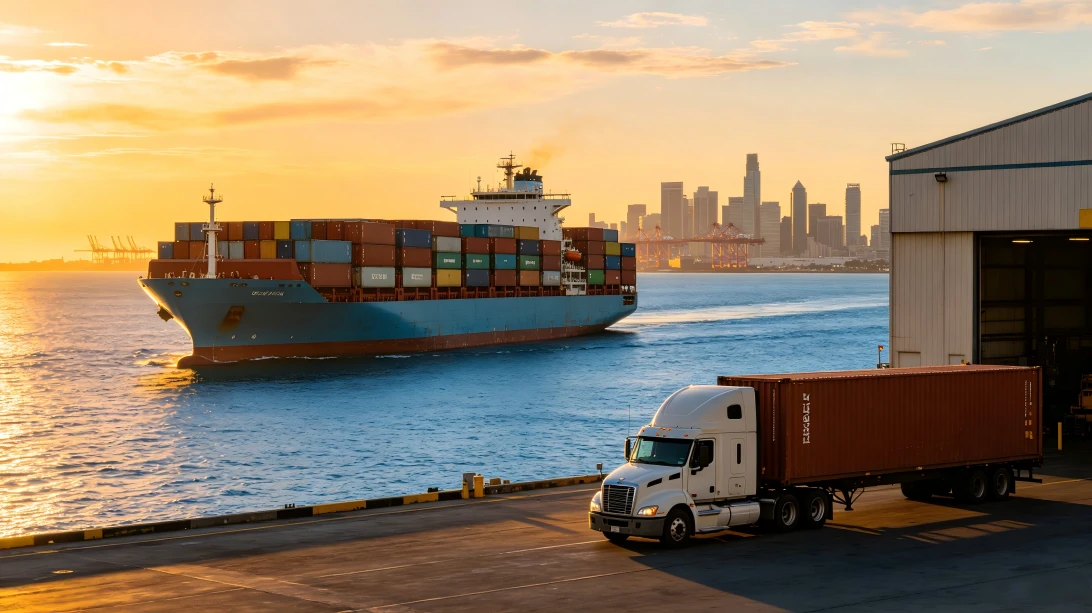
What Is DDP Shipping? A Quick Incoterms 2020 Refresher
DDP (Delivered Duty Paid) Defined
Under Incoterms 2020, DDP places maximum obligation on the seller. The seller bears all costs and risks until the goods are made available for unloading at the buyer’s named destination �?anywhere in the United States. In practical terms, that means one price covers factory pickup, export Customs Clearance in China, ocean freight, US import customs clearance, all Duties and Taxes, and final delivery to your door.
The buyer’s only job is to unload.
Think of it as the “white-glove” option of international shipping. You do not negotiate with a US customs broker. You do not calculate Harbor Maintenance Fees. You do not panic when CBP flags a container for examination. Your forwarder handles every layer of complexity.
DDP vs. DAP vs. FOB: Which Incoterm Should You Use?
Not every shipment should move DDP. The right Incoterm depends on your experience, volume, and internal resources.
| Factor | DDP (Delivered Duty Paid) | DAP (Delivered at Place) | FOB (Free On Board) |
|---|---|---|---|
| Who pays ocean freight | Seller | Seller | Buyer |
| Who handles export customs | Seller | Seller | Seller |
| Who handles US import customs | Seller | Buyer | Buyer |
| Who pays US duties/taxes | Seller | Buyer | Buyer |
| Risk transfer point | Buyer’s destination | Buyer’s destination | Port of origin |
| Best for | First-time importers, SMEs, Amazon FBA sellers | Experienced B2B buyers with US brokers | Large-volume importers with full logistics teams |
When DDP wins: If you do not have a US customs broker on speed dial, if you hate surprise bills, or if you are an Amazon FBA seller who needs compliant inbound logistics without managing CBP yourself, DDP is almost certainly your best option.
When DAP or FOB wins: High-volume B2B importers who can reclaim duties through drawback programs, optimize HTSUS classifications, or negotiate better freight rates directly with carriers often prefer DAP or FOB for greater cost control.
Transparency note: DDP is not always the cheapest Incoterm on paper. But it is the most predictable. We will show you exactly how to evaluate the true landed cost later in this guide.
Why Choose Sea Freight DDP for Your China-to-USA Imports?
The Core Advantages of DDP Ocean Freight
Cost predictability is the headline benefit. When your forwarder quotes a DDP rate, you know your total landed cost before the vessel leaves Shanghai. There are no midnight phone calls about unexpected customs duties, no invoices for Merchandise Processing Fees you have never heard of, and no storage bills because a bond was missing.
Other advantages include:
- Zero customs hassle: You do not need to hire a US customs broker or memorize HTSUS chapters.
- Supply chain simplicity: One point of contact from factory floor to warehouse door. One invoice. One tracking number. These advantages are the foundation of our DDP Shipping from China to USA service, which thousands of importers rely on every month for predictable trans-Pacific logistics.
- Ideal for non-urgent inventory: Ocean freight’s 25�?0 day window aligns perfectly with quarterly inventory planning, seasonal restocks, and bulk procurement cycles.
Who Benefits Most from DDP Sea Freight?
B2B Importers & Wholesalers use DDP to lock in total landed cost per unit. If you sell to retailers on fixed margins, knowing your exact cost of goods sold �?including freight, duties, and delivery �?is invaluable for pricing stability.
Amazon FBA & E-commerce Sellers represent one of our largest client segments. Here is a fact most new sellers do not know: Amazon will NOT act as your Importer of Record. If you ship FOB or DAP into an FBA warehouse, you are personally on the hook for US customs clearance. DDP solves this entirely because your forwarder acts as the IOR.
SMEs Without Logistics Teams simply do not have the headcount to manage bonds, ISF filings, or duty calculations. DDP lets a five-person team import like a fifty-person operation.
When DDP Sea Freight Is NOT the Right Choice
We believe in transparency, not hard sells. DDP is not ideal when:
- You are a high-volume importer who can optimize duty drawback or HTS reclassification to recover significant duty payments.
- You are shipping highly regulated goods (FDA food products, EPA-regulated chemicals, FCC-controlled electronics) where direct compliance oversight is legally critical.
- Your seller or forwarder cannot legally act as the US Importer of Record. In that scenario, “DDP” is a fiction, and you are exposed to massive risk. If your cargo is genuinely time-critical, consider Air Freight DDP Shipping from China to USA as an alternative; transit drops to 5�? days door-to-door.
How Sea Freight DDP Works: The End-to-End Process
Understanding the workflow helps you ask better questions and spot weak forwarders before you hand over your cargo. Here is the complete door-to-door journey.
Step 1: Shipment Booking & Quote Confirmation
You provide cargo dimensions, weight, HS code, pickup address in China, US delivery address, and cargo type (general or restricted). A professional forwarder then builds an itemized quote:
- Origin charges (pickup, export clearance, terminal handling)
- Ocean freight (base rate + fuel surcharge)
- Destination charges (US port handling, drayage, customs brokerage)
- Duties and taxes (HTSUS rate + MPF + HMF + Section 301 if applicable)
- Last-mile delivery
- Service margin
If a quote lumps everything into one line item with no breakdown, that is a red flag.
Step 2: Pickup & Export Clearance in China
The forwarder arranges factory pickup from Shanghai, Shenzhen, Ningbo, Guangzhou, or another origin city. Goods are trucked to the port, where Chinese export customs reviews the Commercial Invoice, Packing List, and export declaration. This stage usually takes 1�? days.
Step 3: Ocean Transit
The vessel departs. You receive a Bill of Lading (B/L) and a tracking link. Port-to-port sailing times vary by route �?we cover exact timelines in the next section.
Step 4: US Customs Clearance
This is where most DDP shipments succeed or fail. Before the vessel even arrives, your forwarder must:
- File the ISF “10+2” (at least 24 hours before cargo is laden aboard the vessel �?see our deep dive in the US Customs section below).
- Activate the customs bond.
- Submit CBP Form 3461 for cargo release and Form 7501 for the formal entry summary.
- Pay duties, MPF, and HMF.
If any of these steps are missing or late, your container sits at the port. Under true DDP terms, the seller pays those storage fees �?but your inventory plan still suffers.
Step 5: Inland Transport & Final Delivery
After CBP release, the container moves by drayage to a local warehouse, then by LTL or FTL trucking to your business address, Amazon FBA warehouse, or residential address. You sign the proof of delivery, receive the customs entry paperwork, and the DDP obligation is complete.
FCL vs. LCL: Choosing the Right Container for DDP Sea Freight
Full Container Load (FCL): When Bigger Is Cheaper
FCL means your cargo occupies an entire container. Standard options for China-USA DDP include:
| Container | Internal Dimensions (L × W × H) | Max Payload | Typical CBM |
|---|---|---|---|
| 20GP | 5.9 m × 2.35 m × 2.39 m | ~21,700 kg | 28�?0 CBM |
| 40GP | 12.03 m × 2.35 m × 2.39 m | ~26,500 kg | 58�?0 CBM |
| 40HQ | 12.03 m × 2.35 m × 2.69 m | ~26,500 kg | 68�?0 CBM |
FCL is best for bulk shipments, large cartons, and cargo that benefits from minimal handling. Because the container is sealed at origin and opened only at destination, theft and damage risks drop significantly. If you know your volumes justify a full container, our dedicated FCL Sea Freight DDP from China to USA guide walks through load plans, weight limits, and rate negotiation in greater detail.
Less than Container Load (LCL): Flexible for Smaller Volumes
LCL means your cargo shares container space with other shipments. A freight forwarder consolidates multiple clients’ cargo into one container at a Chinese warehouse, then deconsolidates it at a US warehouse.
LCL works best for:
- 1�?2 CBM shipments
- Trial orders or product samples
- Mixed-SKU cargo that does not fill a container
Risk note: Every time cargo is handled �?loaded into a consolidation warehouse, shifted at the port, unloaded at deconsolidation �?damage risk increases slightly. Build in extra transit time (typically 3�? days) for consolidation and deconsolidation. For a complete cost breakdown of shared-container shipping, see our LCL Ocean DDP Shipping from China to USA resource.
The FCL vs. LCL Decision Breakpoint
The most common question we hear is: “At what volume should I switch from LCL to FCL?”
| Scenario | Recommended Mode | Why |
|---|---|---|
| 1�? CBM | LCL | Per-CBM rate is economical; no wasted space penalty |
| 8�?5 CBM | LCL or FCL | Evaluate total cost; FCL may win if cargo is dense |
| 15+ CBM | FCL (20GP) | Almost always cheaper per unit; faster handling |
| 55+ CBM | FCL (40HQ) | Maximum cube efficiency for high-volume importers |
The general rule for China→USA lanes: ~12�?5 CBM is the typical crossover point where FCL becomes cheaper than LCL on a per-unit basis. However, cargo density matters. Heavy, dense cargo (machinery, tiles) hits weight limits before cube limits, while light, bulky cargo (furniture, insulation) is all about cubic meters.
Container Loading Optimization Tips
- Maximize cube utilization: A poorly loaded 40HQ can waste 10�?5% of its volume. Use loading software or ask your forwarder for a loading plan.
- Palletization vs. floor-loaded: Palletized cargo is faster to unload but consumes more cube. Floor-loaded cartons maximize space but increase labor costs at destination. For DDP, the seller pays unloading labor �?so your forwarder’s choice affects their margin, not yours.
- Weight distribution: US chassis have strict weight limits. An overweight container can trigger fines or require costly transloading �?and under DDP, that is the seller’s problem, not yours.
China to USA Routes & Transit Times: Port-by-Port Breakdown
Major China Origin Ports
Shanghai handles the largest volume of China-USA cargo. It offers the most carrier options, competitive rates, and reliable schedules. If your supplier is anywhere in the Yangtze River Delta, Shanghai is usually the default.
Shenzhen / Guangzhou dominate South China exports. If your factory is in the Pearl River Delta (Dongguan, Foshan, Zhongshan), routing through Shenzhen or Guangzhou saves 1�? days of domestic trucking and often offers slightly faster ocean transit to the US West Coast.
Ningbo is a strong alternative to Shanghai with marginally lower port congestion. Many forwarders offer competitive Ningbo rates to diversify risk.
Qingdao, Xiamen, and Tianjin serve regional specialization. Qingdao for northern manufacturing, Xiamen for Fujian province, Tianjin for Beijing-Tianjin-Hebei corridor. For importers with parallel European distribution needs, our Sea Freight DDP Shipping from China to UK overview compares ocean and rail bridge options.
Major US Destination Ports
West Coast
- Port of Los Angeles / Long Beach: The busiest US gateway for China cargo. Fastest transit times, but periodic congestion and labor disputes can cause delays.
- Port of Seattle / Tacoma: Alternative for Pacific Northwest destinations; slightly less congested than LA/LB.
East Coast
- Port of New York / New Jersey: The dominant East Coast entry. Longer ocean transit, but avoids West Coast rail bottlenecks.
- Port of Savannah: Growing rapidly; excellent for Southeast US distribution.
- Port of Charleston: Alternative Southeast option with strong intermodal connections.
Door-to-Door Transit Time Table
| Route | Port-to-Port | Door-to-Door (Typical) |
|---|---|---|
| Shanghai �?Los Angeles | 14�?8 days | 25�?2 days |
| Shanghai �?New York | 26�?2 days | 35�?5 days |
| Shenzhen �?Los Angeles | 13�?6 days | 22�?0 days |
| Shenzhen �?New York | 28�?5 days | 38�?8 days |
| Ningbo �?Savannah | 24�?0 days | 32�?0 days |
| Ningbo �?Los Angeles | 14�?8 days | 25�?3 days |
| Inland rail (West Coast �?Midwest) | �? | +5�?0 days |
Note: Door-to-door estimates include pickup, export clearance, sailing, US customs, and final delivery. Actual times vary by season, customs examination rates, and inland destination.
West Coast vs. East Coast: Which Route Should You Choose?
Choose West Coast if your warehouse or Amazon FBA destination is in California, Nevada, Arizona, or the Pacific Northwest. The ocean leg is shorter and cheaper, though inland rail to the Midwest can add 5�?0 days.
Choose East Coast if your final destination is in the Northeast, Southeast, or Midwest. While the ocean crossing is 10�?4 days longer, you avoid West Coast port congestion and the uncertainty of intermodal rail transfers. For time-sensitive inventory, some importers find the direct East Coast route more reliable despite the longer sail.
Cost impact: East Coast DDP quotes typically run 15�?5% higher than West Coast quotes for identical cargo, due to longer ocean freight and higher inland trucking costs from East Coast ports. Importers with multi-destination North American supply chains can also explore our FCL Sea Freight DDP from China to Canada service, or review Sea Freight DDP Shipping from China to Mexico for Pacific and Atlantic routing into Latin America.
DDP Sea Freight Costs & Pricing: 2026 Rates Explained
How a DDP Quote Is Built
Understanding the anatomy of a DDP quote protects you from hidden fees and helps you compare apples to apples.
| Cost Component | What It Covers | Who Pays Under DDP |
|---|---|---|
| Origin charges | Factory pickup, China export clearance, terminal handling, documentation | Seller / Forwarder |
| Ocean freight | Base rate + BAF (fuel surcharge) + peak season surcharge | Seller / Forwarder |
| Destination charges | US port handling, drayage, customs brokerage | Seller / Forwarder |
| Duties & taxes | HTSUS duty + MPF (0.3464%) + HMF (0.125%) + Section 301 tariffs | Seller / Forwarder |
| Last-mile delivery | LTL/FTL trucking to final address | Seller / Forwarder |
| Forwarder margin | Service fee built into the all-in rate | Seller / Forwarder |
The buyer pays one all-in DDP price. Every line item above is the forwarder’s responsibility to manage and pay.
Indicative DDP Sea Freight Rates (June 2026)
The following ranges are for general cargo, non-peak season, and major port pairs. Rates fluctuate weekly based on fuel costs, capacity, and demand.
| Service | West Coast DDP | East Coast DDP |
|---|---|---|
| LCL | $180–$350 per CBM | $220–$420 per CBM |
| FCL 20GP | $3,800–$6,500 | $4,800–$7,500 |
| FCL 40HQ | $4,800–$8,200 | $6,000–$9,500 |
Caveat: These are indicative ranges for budget planning only. Product type, HS code duty rate, exact origin/destination addresses, and seasonality can shift quotes significantly. Contact us for a precise, itemized quote.
Sample Landed Cost Calculation
Let us walk through a realistic scenario: a 20GP container of consumer electronics shipped DDP from Shenzhen to Los Angeles, with a CIF value of $45,000.
| Cost Component | Calculation | Amount |
|---|---|---|
| Origin charges | Pickup, export clearance, docs | $450 |
| Ocean freight (20GP) | Base + BAF | $2,800 |
| Destination charges | Port handling, drayage, brokerage | $850 |
| Customs duty (4% HTSUS) | $45,000 × 4% | $1,800 |
| Section 301 tariff (25%) | $45,000 × 25% | $11,250 |
| MPF (0.3464%) | $45,000 × 0.3464% | $155.88 |
| HMF (0.125%) | $45,000 × 0.125% | $56.25 |
| Last-mile delivery | LA warehouse delivery | $420 |
| Total DDP Quote | $17,782.13 |
Under DAP, you would still pay the freight forwarder roughly $5,100 for origin, ocean, and destination �?but you would separately pay a customs broker (~$300), the duty ($1,800), Section 301 ($11,250), MPF ($155.88), and HMF ($56.25) yourself. The total is similar, but the administrative burden and cash-flow timing are entirely different.
🚩 Red Flags: How to Spot a Shady DDP Quote
If a quote triggers any of these warnings, walk away:
- 30%+ cheaper than competitors with no clear explanation.
- The forwarder cannot name the Importer of Record who will clear US customs.
- No mention of ISF filing or customs bond in the quote breakdown.
- Vague HS code classification (“general goods” instead of a specific HTSUS code).
- No cargo insurance option offered.
- Forwarder lacks verifiable FMC/NVOCC license.
In our experience, the cheapest DDP quote is often the most expensive one in disguise.
US Customs Clearance for DDP Shipments: The Detail Most Guides Skip
This is where the majority of “China to USA DDP” guides fall apart. They mention “customs clearance” in passing and move on. But if you are trusting a forwarder to clear US Customs and Border Protection (CBP) on your behalf, you deserve to know exactly what that involves.
Who Is the Importer of Record (IOR) �?And Why It Matters
Under US CBP law, the Importer of Record (IOR) is the entity legally responsible for ensuring the shipment complies with all US laws and for paying duties. In a true DDP shipment, the seller or their appointed forwarder must act as the IOR.
The problem: Most Chinese sellers do not have a US entity or tax ID, making it impossible to legally serve as IOR.
The solution: Experienced forwarders arrange third-party IOR services or use their own US affiliate and customs bond to fulfill this role. At DDPShipping, we handle IOR setup as a standard part of our DDP service.
The risk of getting it wrong: If your forwarder cuts corners and uses a fake or borrowed IOR, CBP can seize cargo, levy fines, or initiate an audit that disrupts your entire supply chain.
Customs Bonds: Single Entry vs. Continuous
Before CBP will release cargo, they require a customs bond �?a financial guarantee that duties and fees will be paid.
| Bond Type | Coverage | Best For | Typical Cost |
|---|---|---|---|
| Single Entry Bond (SEB) | One shipment | Occasional importers; one-off DDP orders | $50–$150 + bond value |
| Continuous Bond | All imports for 12 months | Frequent importers; monthly FCL/LCL shippers | $500–$700/year |
Under DDP, your forwarder arranges the bond. But you should verify it exists. Ask your forwarder: “Who holds the bond for this shipment, and can you provide the bond number?”
ISF “10+2” Filing: The Rule That Can Cost You $10,000
The Importer Security Filing (ISF) �?commonly called “10+2” �?is mandatory for all ocean cargo entering the United States.
- Who files: Under DDP, the forwarder or their US customs broker files on the seller’s behalf.
- Deadline: At least 24 hours before cargo is laden aboard the vessel at the foreign port.
- Penalties: CBP may assess civil penalties of $5,000–$10,000 for late, inaccurate, or missing filings �?and yes, the agency enforces this regularly.
The “10” refers to data elements submitted by the importer (seller/forwarder under DDP): manufacturer, seller, buyer, ship-to party, container stuffing location, consolidator, importer of record, consignee, country of origin, and commodity HTSUS number. The “+2” comes from the carrier: vessel stow plan and container status messages.
If your forwarder cannot confirm ISF was filed on time, that is a serious warning sign.
Section 301 Tariffs: The China-Specific Cost You Cannot Ignore
Since 2018, the Office of the United States Trade Representative (USTR) has imposed additional duties of 7.5% to 25%+ on many products manufactured in China under Section 301 of the Trade Act of 1974. These are on top of standard HTSUS duty rates.
Why this matters for DDP: Your forwarder must calculate and prepay these tariffs. A product with a 4% standard duty rate might actually carry a 29% total duty burden when Section 301 is applied. If your forwarder underestimates or ignores Section 301, they either absorb a massive loss (unlikely) or cut corners elsewhere (dangerous).
You can check whether your product is affected by searching the USTR Section 301 tariff list or verifying your HTSUS code on the CBP website.
MPF, HMF, and Other Non-Negotiable US Fees
Two federal fees apply to nearly every ocean import into the USA. No forwarder can waive them. They must be included in any honest DDP quote.
- MPF (Merchandise Processing Fee): According to US Customs and Border Protection (CBP), this fee is assessed at 0.3464% of the cargo value, with a statutory minimum of $31.67 and maximum of $614.35.
- HMF (Harbor Maintenance Fee): Also collected by CBP, this fee equals 0.125% of the cargo value and applies only to ocean freight �?not air.
On a $50,000 shipment, MPF + HMF adds roughly $235. That is not optional. If your quote does not show these fees, ask why.
HTSUS Classification: Why the Right Code Saves Money
HTSUS (Harmonized Tariff Schedule of the United States) codes determine how much duty you pay. While the first six digits of an HTSUS code align with the international HS system, the last four digits are US-specific.
Wrong classification leads to overpayment or CBP penalties. Before you accept a DDP quote, ask your forwarder: “What HTSUS code are you using for duty calculation, and can you show me the CBP ruling?”
Required Documents for DDP Sea Freight to USA
- Commercial Invoice (DDP Incoterms clearly stated)
- Packing List (weights, dimensions, carton counts)
- Bill of Lading (B/L) or Sea Waybill
- Certificate of Origin
- Power of Attorney (POA) for the customs broker
- ISF filing confirmation
- Customs Bond evidence
- Import permits/licenses (if regulated: FDA, FCC, EPA, CPSC, etc.)
Common Mistakes & How to Avoid Them
Mistake 1: Choosing the Lowest Quote Without Vetting the Forwarder
Rock-bottom quotes usually mean someone is cutting corners. Common scams include fake IORs, misdeclared HS codes to evade duties, and missing customs bonds. Always verify: FMC license, NVOCC number, US customs broker relationship, and client references.
Mistake 2: Ignoring Product Compliance Requirements
FDA-regulated food, FCC-certified electronics, EPA-controlled vehicles, and CPSC-monitored consumer products all need pre-arrival permits or registrations. Under DDP, your forwarder should flag compliance requirements, but you must inform them accurately about what you are shipping.
Mistake 3: Not Confirming Insurance Coverage
DDP does not automatically include cargo insurance. Ocean freight carries inherent risks: container losses, water damage, and handling accidents. We recommend all-risk marine cargo insurance for every sea freight shipment �?typically 0.3�?.5% of cargo value.
Mistake 4: Poor Documentation from the Chinese Supplier
Inconsistent commercial invoice values versus packing lists, vague product descriptions (“machine parts” instead of “stainless steel bearings, HS 8482.10”), and missing country-of-origin markings are among the top reasons CBP flags shipments for examination. Review documents before cargo departs.
Mistake 5: Booking Too Late During Peak Season
August through November is peak season for China-USA ocean freight. Rates can spike 20�?0%, and container availability tightens. Book 6�? weeks ahead for FCL and 4�? weeks ahead for LCL during this window. In our experience managing DDP shipments during this period, the weeks leading up to Golden Week (early October) and the Black Friday rush are the two highest-risk windows �?we have seen LCL consolidation warehouses hit capacity and rates jump as much as 50% in a single week.
How to Choose a Reliable DDP Freight Forwarder for China-to-USA Shipments
The 7-Point Evaluation Checklist
- Licenses & Compliance: Verify FMC-registered NVOCC status and a legitimate US customs broker partnership.
- China-USA Lane Experience: How many years have they managed this specific trade lane? What is their monthly shipment volume?
- Transparent Pricing: The quote should itemize origin, freight, destination, duties, and margin separately �?not one lump sum.
- IOR Capability: Can they legally act as Importer of Record? Do they have a US entity or active customs bond?
- Technology & Tracking: Real-time visibility from factory pickup to final delivery is non-negotiable in 2026.
- Warehouse Network: Origin consolidation (for LCL) and destination deconsolidation capabilities reduce costs and transit times.
- Reviews & References: Ask for testimonials from businesses similar to yours �?Amazon sellers, B2B wholesalers, or industrial importers.
Why DDPShipping Is the Trusted Choice for DDP Sea Freight
We are not a generalist logistics provider. For over a decade, DDPShipping has specialized exclusively in global DDP door-to-door service. That focus means:
- All-inclusive rates with no hidden fees �?what we quote is what you pay.
- Full customs clearance and duty/tax handling on both sides of the Pacific, including IOR arrangement, ISF filing, and bond management.
- Proven track record with B2B importers, Amazon FBA sellers, and SMEs who need predictable, hassle-free shipping.
- Real-time tracking and dedicated account management from pickup to delivery.
If you are ready to stop worrying about customs paperwork and start focusing on growing your business, Contact DDPShipping to request a precise, itemized DDP sea freight quote.
After Your Shipment Arrives: Receiving, Inspection & Record-Keeping
The DDP Receiving Checklist
When your DDP shipment arrives, follow this protocol before signing the delivery receipt:
- Inspect outer packaging for water damage, tears, or punctures.
- Count pallets and cartons against the Packing List.
- Photograph any damage immediately �?before the driver leaves.
- Note discrepancies on the proof of delivery. Under DDP, risk transfers at delivery, so damage claims after you sign are significantly harder to pursue.
Documents to Retain for US Tax & Audit Purposes
Keep the following for at least five years:
- Commercial invoice and packing list
- Bill of Lading
- CBP Form 7501 (entry summary)
- Duty payment receipts
- ISF filing confirmation
CBP can audit import entries within a five-year window. Organized records save you enormous headaches if questions arise.
A Brief Note on Duty Drawback
If you later export the imported goods �?or manufacture them into products that are exported �?you may be eligible for a duty drawback refund of up to 99% of duties paid. It is an advanced topic, but high-volume B2B importers should consult a drawback specialist to explore potential recoveries.
FAQ: Sea Freight DDP from China to USA
How long does DDP sea shipping take from China to USA? West Coast deliveries typically arrive in 25�?5 days door-to-door. East Coast deliveries take 35�?8 days. Inland Midwest destinations add 5�?0 days from the West Coast port.
What documents are needed for DDP sea freight from China to USA? You need a commercial invoice, packing list, Bill of Lading, certificate of origin, Power of Attorney for the broker, ISF filing confirmation, customs bond evidence, and any product-specific permits (FDA, FCC, EPA, etc.).
Is DDP shipping from China to USA legal? Yes, provided the seller or forwarder legally acts as the US Importer of Record. Many cheap quotes bypass this requirement illegally, exposing the buyer to seizure and fines.
What is included in a DDP sea freight quote? Origin pickup, China export clearance, ocean freight, US customs clearance, all duties and taxes, and last-mile delivery to your specified address.
How much does DDP sea freight from China to USA cost in 2026? Indicative ranges: LCL $180–$420 per CBM; FCL 20GP $3,800–$7,500; FCL 40HQ $4,800–$9,500. Exact costs depend on cargo details, HTSUS classification, and seasonality.
Can I use DDP for Amazon FBA shipments from China? Absolutely. It is one of the most popular methods for FBA inbound logistics. Amazon does not act as IOR, so your forwarder must handle US customs clearance.
What is the difference between DDP and DAP for sea freight? Under DDP, the seller pays duties and handles import customs. Under DAP, the buyer pays duties and hires their own US customs broker.
What are Section 301 tariffs, and do they affect DDP pricing? Yes. Many Chinese-made products face additional duties of 7.5% to 25% or more. Under DDP, your forwarder calculates and prepays these tariffs as part of the all-in quote.
What happens if my DDP shipment is held by US customs? CBP may examine the cargo for compliance. Under DDP, the seller or forwarder pays exam fees and storage costs �?but the delay still affects your inventory timeline.
Does DDP include cargo insurance? No, not automatically. Request all-risk marine cargo insurance separately. Typical cost is 0.3�?.5% of cargo value.
What is the de minimis threshold for USA imports? According to CBP, the de minimis threshold is currently $800 per shipment per day. Goods below this threshold may enter duty-free, but DDP sea freight shipments almost always exceed this value.
Should I choose West Coast or East Coast port for DDP sea freight? West Coast is faster and cheaper for most cargo. East Coast avoids West Coast rail bottlenecks and is closer to final destinations in the Northeast and Southeast.
At what volume should I switch from LCL to FCL? Generally around 12�?5 CBM, though cargo density and destination also influence the decision.
Can a small business use DDP sea freight from China? Yes. DDP is specifically designed for SMEs and first-time importers who lack in-house customs expertise.
How do I know if my DDP forwarder is legitimate? Check their FMC/NVOCC registration, ask who will serve as IOR, request an itemized quote, and verify their US customs broker relationship.
Conclusion: Make Your Next China-to-USA Import Simple, Predictable, and Profitable
Sea freight DDP shipping from China to USA removes the complexity that kills margins and delays inventory. One quote. One contact. Zero customs surprises.
Success comes down to three principles:
- Choose a licensed, transparent forwarder who itemizes every cost and can name your Importer of Record.
- Plan 3�? months ahead for sea freight lead times, especially if you are importing for seasonal sales windows.
- Understand the basics of US customs �?ISF, bonds, Section 301, and MPF/HMF �?so you can ask smart questions and spot red flags before they become expensive problems.
At DDPShipping, we have spent over ten years refining a DDP service that lets importers focus on selling, not customs paperwork. If you are ready for a precise, all-inclusive quote with no hidden fees, reach out today. We will handle the complexity �?you handle the growth.