
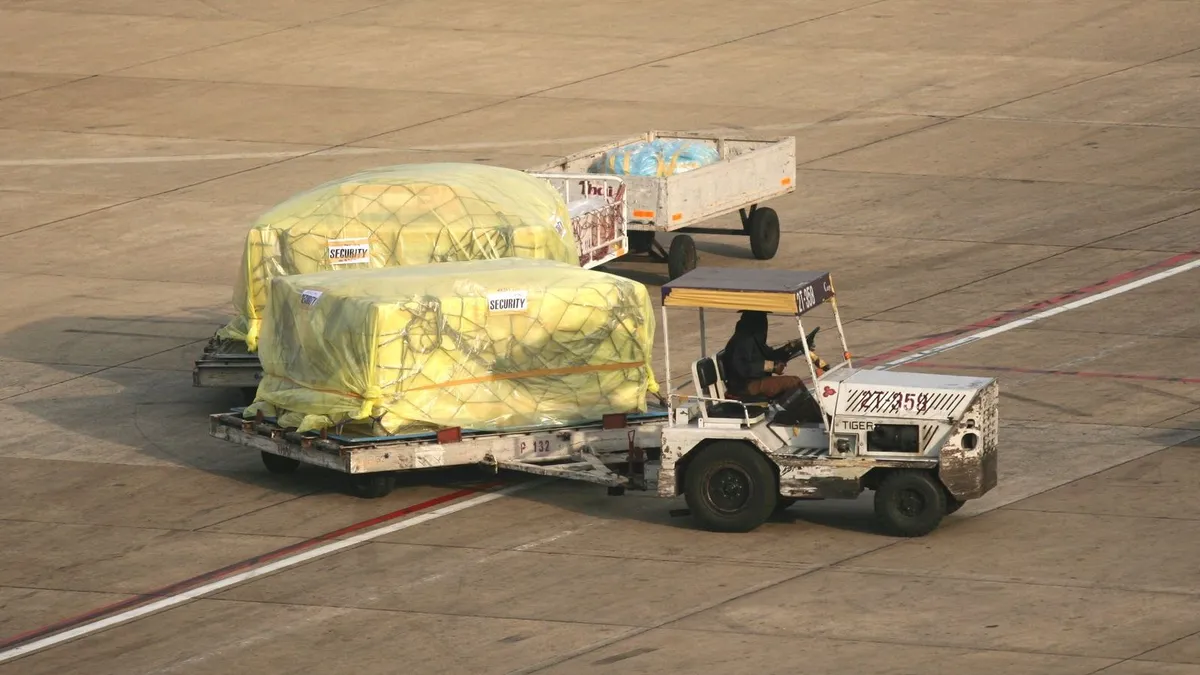
Air freight DDP shipping from China to Germany gets quoted as a single per-kilo number, and almost every dispute about it starts at the same place: the number was right, but it was never the whole number. A 300 kg shipment to Bavaria pays freight, and then it pays duty, and then it pays 19% import VAT on a base that includes the freight and the duty. In late 2026 the VAT line is frequently larger than the air freight line.
Everything below was checked on 3 November 2026. Rate bands come from published forwarder quotation data, duty rates from the Common Customs Tariff, and the VAT rules from German statute as it now stands.
How much does air freight DDP from China to Germany cost in 2026
Door-to-door air freight, general cargo, net of duty and VAT, priced through Frankfurt. These are median values from about 630 China to Germany air quotations collected between August and early October 2026.
| Chargeable weight | Typical per kg | Middle-half range per kg | Typical per shipment |
|---|---|---|---|
| 45 to 99 kg | €13.72 | €11.63 to €15.24 | €890 |
| 100 to 299 kg | €7.56 | €7.10 to €8.15 | €1,750 |
| 300 to 999 kg | €6.05 | €5.67 to €6.50 | €3,070 |
| 1,000 kg and above | €4.95 | €4.79 to €5.12 | €6,770 |
Two things about that table matter more than the numbers.
The first is the cliff between 45 and 100 kg. Below roughly 45 kg the airline does not sell by the kilo at all, it sells a minimum charge, and the same data set puts that minimum at about €1,110 per shipment. Our own floor is 45 kg, which happens to be exactly the point where per-kilo pricing becomes real.
The second is that the band boundaries are worth engineering around. A 290 kg shipment at €7.56 per kg costs €2,192. A 310 kg shipment at €6.05 per kg costs €1,876. Fifty kilos more cargo, €316 less freight, because the shipment crossed into a lower rate band. If a supplier is 60 kg short of a band, waiting a week for the balance is often cheaper than flying now.
For context on the airport-to-airport leg alone, Xeneta measured a China to Western Europe air cargo spot rate of about USD 3.85 per kg in August 2026. That figure is the corridor, not your German address. The gap between $3.85 and €7.56 is fuel, security screening, terminal handling at both ends, customs brokerage, delivery, and the forwarder’s margin.
Why the per-kilo rate you were quoted does not match the invoice
Air freight bills on chargeable weight, not on what the pallet weighs on a scale. The industry divisor is 6,000 cubic centimetres per kilo, which means one cubic metre equals 167 kg. Whichever figure is higher, actual or volumetric, is what you pay for.
A crate of apparel at 320 kg and 3.1 CBM bills as 518 kg. That is a 62% surcharge on a shipment that never saw a scale above 320.
On top of the base rate come items that are rarely in the first quote:
- Fuel surcharge (FSC). Typically USD 0.30 to 1.50 per kg, or 10% to 30% of the base rate, reset monthly against jet fuel.
- Security surcharge (SSC). About USD 0.06 to 0.20 per kg. All air cargo is screened before loading and this line pays for it.
- Air waybill fee. Per shipment, not per kilo.
- Terminal handling at origin and at Frankfurt, plus customs brokerage, plus the delivery leg inside Germany.
- Duty and import VAT. Never inside a per-kilo rate, whatever the quote says.
Ask for the quote in the same units you will be invoiced in: chargeable weight, all-in per kg, and the list of surcharges included. A rate that cannot state its divisor is a rate you cannot compare.
How long a DDP air shipment really takes
Flight time is the short part. The door-to-door clock looks like this for a shipment through Frankfurt.
| Stage | Elapsed |
|---|---|
| Supplier pickup, export declaration, screening | Day 0 to 1 |
| Flight, direct China to Frankfurt | About 12 hours airborne |
| Flight with one connection | 18 to 24 hours airborne |
| Arrival, import declaration in ATLAS, release | 1 to 2 working days |
| Trucking to the German address | 1 to 2 days |
Realistic door-to-door for a booking that is cargo-ready on a Monday morning is Wednesday to Friday of the following week: 5 to 8 days. A Friday cut-off pushes it a week, because the export declaration and the airline slot both close before the aircraft does. The Q4 market band quoted by forwarders for air under DDP into Germany is 5 to 8 days, and that matches what we see operationally.
One date is fixed by EU law rather than by the airline. The entry summary declaration has to sit in ICS2 before the cargo is loaded at the Chinese airport, not on arrival. If the house-level data is not filed, the cargo does not board. That filing needs the real description, HS code and consignee details, which is why “we will sort the paperwork at the other end” is not a plan.
Which German airport the cargo lands at
Frankfurt (FRA) is the default and handles the widest spread of Chinese lanes and carriers. Munich (MUC) works well for southern Germany and Austria. Leipzig/Halle (LEJ) is a dedicated freighter hub and often has better slots than passenger-belly capacity. Cologne/Bonn (CGN) handles a narrower set of carriers.
On the Chinese side, the usual gateways are Shanghai PVG, Shenzhen SZX, Guangzhou CAN, Hong Kong HKG and Beijing PEK. The origin airport is not a free choice: it follows the airline that has capacity on the date you need. A quote that names a departure airport you cannot reach cheaply by truck is a quote with a hidden line item.
Choosing FRA for everything is the common mistake. For a delivery address in Bavaria, MUC or even a truck from LEJ can beat FRA once the Frankfurt handling and the run south are priced in. Ask for two airport options on anything above 300 kg.
Who is the importer of record, and why it decides the 19%
This is the section that separates a real DDP quote to Germany from one that only looks like DDP.
Someone must be the declarant on the German import declaration. That person owes the duty and the 19% import VAT to customs. What happens next depends entirely on who that person is.
If the buyer holds the EORI and the forwarder declares as direct representative, the buyer is the debtor. The buyer receives the ATLAS import duty assessment notice, deducts the 19% as input tax under §15(1) UStG, and the VAT is a cash-flow item, not a cost. A German company with a German VAT registration wants exactly this.
If the forwarder or the Chinese seller uses its own EORI as importer of record, which is what most cheap “DDP” quotes actually do, the VAT story changes. The supply is then treated as a domestic supply in Germany under §3(8) UStG. Whoever made that supply has to be registered for German VAT and has to charge German VAT on its invoice. The buyer cannot deduct the import VAT, even where the amount is recharged to it and even where its name appears on the assessment notice. What the buyer receives is a commercial invoice, not an import VAT document it can put through its return.
A non-EU business that wants to act as importer of record in Germany also needs a fiscal representative under §§22d to 22f UStG. That is a real appointment with real cost, and it is the reason a genuine DDP structure to Germany is not something a forwarder can improvise on a Tuesday.
What this means in money. On the 320 kg apparel shipment in the next section, import VAT comes to €3,741.55. If the buyer is the importer of record, that is €3,741.55 of working capital returned on the next VAT return. If the forwarder is the importer of record and the buyer cannot deduct, it is €3,741.55 of cost on top of a €3,132.09 freight bill. Same aircraft, same pallet, different legal structure, and the shipment became 119% more expensive.
Timing softens the cash-flow version of this. With a deferment account, deferred import VAT falls due on the 26th of the second month after the month of import, under §21(3a) UStG. A genuine offsetting model, where import VAT is declared and deducted in the same return and never paid to customs, was agreed by the state finance ministers on 10 September 2026 for 1 January 2030 and is still waiting for legislation. Until then, deferment is the practical answer.
One further warning that belongs here. Import VAT is an import duty in the criminal-law sense. Undervaluing a shipment to shrink it is prosecutable under §370 AO, and customs can reopen an assessment for three years, five in cases of recklessness and ten in cases of evasion. A DDP rate that sits below cost plus duty plus VAT is not a discount, it is a valuation that will be tested later, usually after the goods have been sold.
What Zoll charges: duty on the CIF value, then VAT on top
There is no EU-China free trade agreement, so Chinese origin goods pay MFN rates from the Common Customs Tariff. Duty is assessed on the customs value, which for these shipments means the goods value plus freight and insurance to the point of entry. Import VAT at 19% is then charged on the customs value plus the duty. The freight is taxed twice, once as part of the duty base and once as part of the VAT base.
| Product | HS heading | MFN duty |
|---|---|---|
| Laptops, smartphones, integrated circuits | 8471, 8517.12, 8542 | 0% |
| Electronic components, connectors | 8534, 8542 | 0% |
| Cosmetics and skincare | 3304 | 1.7% |
| Machinery parts | 8483 | 1.7% |
| Furniture | 9403 | 3.7% |
| Automotive parts | 8708 | 3.7% |
| Tyres | 4011 | 4.5% |
| Aluminium profiles | 7610 | 6% |
| Apparel | 61, 62 | 12% |
| Footwear | 6402 to 6405 | 17% |
Two additions sit outside the table. Anti-dumping duties apply on top of the MFN rate to a defined list that includes e-bikes, solar glass, ceramics, certain steel products and aluminium products. And the 19% is the standard rate; a narrow list of goods, books and some food among them, uses the 7% reduced rate.
The classification is yours to defend, not the forwarder’s. A wrong HS code moves the duty rate and, because VAT is charged on the duty-inclusive value, it moves the VAT too.
Three shipments, costed end to end
Freight at the 2026 band rates above, insurance at 0.35% of goods value, duty at the MFN rate, VAT at 19% on the duty-inclusive value. Figures are rounded to the cent and the columns add.
Shipment A: 120 kg of integrated circuits, 0.6 CBM, invoice €9,000.
| Line | Amount |
|---|---|
| Air freight, 120 kg chargeable at €7.56 | €907.20 |
| Cargo insurance | €31.50 |
| Duty at 0% on €9,938.70 | €0.00 |
| Import VAT at 19% on €9,938.70 | €1,888.35 |
| Total charged at import | €2,827.05 |
| Net cost if the buyer is importer of record | €938.70 |
Volume is irrelevant here: 0.6 CBM bills as 100 kg, actual weight is 120 kg, so the scale wins. Duty is nil because the goods are nil-rated, which is why the fastest air shipments in this trade tend to be electronics.
Shipment B: 320 kg of apparel, 3.1 CBM, invoice €14,400.
| Line | Amount |
|---|---|
| Air freight, 517.7 kg chargeable at €6.05 | €3,132.09 |
| Cargo insurance | €50.40 |
| Duty at 12% on €17,582.49 | €2,109.90 |
| Import VAT at 19% on €19,692.39 | €3,741.55 |
| Total charged at import | €9,033.94 |
| Net cost if the buyer is importer of record | €5,292.39 |
Chargeable weight is 517.7 kg against 320 kg actual, and duty almost matches freight. This is the profile where air is usually the wrong mode unless the season is already sold.
Shipment C: 1,150 kg of machinery parts, 2.4 CBM, invoice €52,000.
| Line | Amount |
|---|---|
| Air freight, 1,150 kg chargeable at €4.95 | €5,692.50 |
| Cargo insurance | €182.00 |
| Duty at 1.7% on €57,874.50 | €983.87 |
| Import VAT at 19% on €58,858.37 | €11,183.09 |
| Total charged at import | €18,041.46 |
| Net cost if the buyer is importer of record | €6,858.37 |
Dense machinery is where air per kilo looks least bad, and where the VAT line dominates everything else. €11,183 of VAT against €5,692 of freight is not an unusual ratio for Germany.
Do the new EU parcel charges apply to your air shipment
Two charges took effect in the second half of 2026 and both get mixed into DDP quotes for Germany, often wrongly.
The €3 customs duty applies to goods sold in distance sales, in consignments with an intrinsic value up to €150, at €3 per item. It has applied since 1 July 2026 under Council Regulation (EU) 2026/382 and runs until 1 July 2028, when normal duty rates take over.
The €2 Union handling fee applies from 1 November 2026 to goods sold in distance sales at any value, at €2 per item, under Article 20 of the new Union Customs Code, Regulation (EU) 2026/2108. It is charged per declaration line whatever the quantity, it is never refunded, and TARIC code Y126 has been mandatory on H1, H6 and H7 declarations since the same date to trigger it. Both charges sit inside the VAT base.
The word that decides everything here is distance sale. These are consumer sales, B2C, one consignor to one consumer. A 300 kg air shipment to a German company on commercial terms is not a distance sale and pays neither charge; it pays MFN duty at its own rate instead. Sellers who move 45 kg to 500 kg of consumer stock into a German warehouse and then fulfil locally are outside the fee on the inbound leg. Sellers shipping parcel by parcel from China direct to German consumers are inside it, at €5 per declaration line on top of the 19%.
Which German registers must exist before the plane lands
German customs clears goods. It does not check product registers, and that is exactly why these are discovered later, usually by the marketplace or the authority rather than the forwarder.
Since 12 August 2026 the EU Packaging and Packaging Waste Regulation, Regulation (EU) 2025/40, and the German implementing act VerpackDG govern packaging. Anyone who places packaged goods on the German market for the first time has to be registered in the LUCID register before doing so and has to have the packaging volume contracted into a dual system. Producers without a German establishment need an authorised representative for packaging.
| Product type | Register | Who has to act |
|---|---|---|
| Any packaged consumer goods | LUCID (ZSVR) plus a dual system | Producer or importer first placing goods on the German market |
| Electrical and electronic equipment | Stiftung EAR, WEEE number, ElektroG | Before first placing on the market; WEEE number on offers and invoices |
| Batteries, including in-device | Stiftung EAR, BattDG, per battery category since 1 January 2026 | Producer responsibility organisation membership or individual compliance |
| Consumer products generally | EU responsible person under GPSR, German-language instructions and warnings | Non-EU manufacturer, via its EU representative |
Under GPSR, in force since 13 December 2024, and the aligned German ProdSG since 19 February 2026, safety information and warnings must be in German. Registrations held in another member state do not carry over into Germany. This is the most common gap we see on a first air shipment to a German marketplace: the goods are perfect, the boxes are compliant, and the seller has no LUCID number and no named EU responsible person.
None of this changes the freight rate. All of it can stop a delivery at the point where a marketplace or a retailer asks for the number.
Documents German customs asks for on an air DDP shipment
- Commercial invoice with Incoterms, HS code, country of origin, EORI of the declarant and the VAT identification numbers of both sides.
- Packing list with dimensions and weights per package, because chargeable weight is checked against it.
- Master and house air waybill.
- Entry summary declaration data filed in ICS2 before loading.
- Import declaration in ATLAS, either an H1 or an H7 depending on the procedure.
- Product compliance evidence where the goods are regulated: CE declaration of conformity, EU responsible person details, LUCID registration number, WEEE number, battery registration.
- For dangerous goods, a shipper’s declaration, the safety data sheet and, for lithium cells, the UN38.3 test summary.
- Heat-treated wood packaging carrying the ISPM 15 mark.
An invoice that shows one lump sum with no HS code is the single most common cause of a two-day clearance delay on air. The forwarder cannot classify on your behalf without a description, and customs will not release without a classification.
Air versus sea versus rail on the same shipment
Per chargeable kilo, priced in late 2026, converted at about €1 = $1.12.
| Mode | Cost basis | Per chargeable kg | Door-to-door |
|---|---|---|---|
| Air under DDP | €6.05 per kg at 300 to 999 kg | €6.05 | 5 to 8 days |
| Sea LCL under DDP | $140 to $230 per CBM | about €0.75 to €1.23 | 30 to 42 days |
| Sea FCL under DDP | from $1,150 per 20ft | under €0.10 per kg at full load | 28 to 40 days |
| Rail under DDP | quoted per slot | between LCL sea and air | 16 to 20 days |
One cubic metre by air costs €1,010 at the 300 kg band. The same cubic metre by sea LCL costs $140 to $230, or €125 to €205 at that rate. Air is five to eight times the cost of sea per unit of volume, not two or three.
That ratio sets the break-even. Air earns its price when the goods are dense in value rather than in weight, when a stock-out costs more than the freight difference, or when the consignment is small enough that sea cannot quote it at all. For a €9,000 pallet of circuits that lands in a week, air at €907 is cheap. For €14,400 of apparel that bills as 518 kg, air at €3,132 plus €2,110 duty plus €3,742 VAT is a different conversation, and rail at 16 to 20 days is usually the answer.
What cannot fly, and what gets held at Frankfurt
Air cargo screening and airline acceptance are stricter than sea, and the rejections are rarely about the goods being illegal. They are about documentation and packing.
- Lithium batteries. Standalone cells (UN3480) are tightened to the point where most carriers refuse them as general cargo; batteries packed with or in equipment (UN3481) move with the right declaration and state of charge limits.
- Magnets, speakers, motors. Magnetic field limits apply and a test report is often requested at acceptance.
- Liquids, aerosols, pastes. Partly dangerous goods, partly a screening problem.
- Powders and loose granules. Extra screening, extra time.
- Packaging that hides the contents. X-ray cannot read a fully sealed, foil-lined carton, and it goes to physical inspection.
Expect a physical inspection to add two working days at Frankfurt and a fee that arrives after the goods. A pallet that is screened clean at origin and documented properly does not get that treatment.
Eight questions that separate two DDP air quotes
- What chargeable weight are you billing, and at what volumetric divisor?
- Is the per-kilo rate all-in, or are FSC, SSC, terminal handling and the AWB fee added later?
- Who is named as importer of record on the German declaration, and whose EORI is used?
- Is the duty included at my HS code’s rate, and is any anti-dumping duty excluded?
- Is the 19% import VAT inside your rate, and can I deduct it?
- What is the door-to-door transit time, and how many days of that are clearance?
- Which airport, and does the rate hold if the delivery address is outside the airport’s natural catchment?
- What is excluded: storage after free time, inspection costs, returns, non-compliant cargo?
A forwarder who answers all eight in writing has priced the shipment. A forwarder who answers two and moves to the next question has priced the flight.
FAQ
How much does air freight DDP from China to Germany cost per kg? Door-to-door and net of duty and VAT, about €13.72 per kg at 45 to 99 kg, €7.56 at 100 to 299 kg, €6.05 at 300 to 999 kg and €4.95 above 1,000 kg, based on 2026 quotation data through Frankfurt. Add duty at your HS rate and 19% import VAT on the duty-inclusive value.
How long does air freight DDP from China to Germany take door to door? Five to eight days for general cargo through Frankfurt: one to two days for collection, declaration and screening, roughly 12 hours airborne on a direct flight, one to two working days for clearance, and one to two days for delivery.
What is the minimum shipment size for air freight to Germany? Airlines price a minimum charge rather than a per-kilo rate below about 45 kg, and that minimum runs around €1,110 per shipment. Our own floor is 45 kg, which is also where per-kilo pricing starts to make sense.
Can I deduct the 19% import VAT in Germany? Only if you are the trader for whose business the goods were imported. In practice that means holding the EORI and being named on the ATLAS assessment notice. If the forwarder or the seller imports under its own EORI, the supply becomes a domestic German supply under §3(8) UStG and the buyer cannot deduct the import VAT even when it is recharged.
Do I need an EORI number for a DDP air shipment to Germany? Not if the forwarder imports under its own EORI, but then you will not be able to deduct the import VAT. If you want the deduction, you need a German or EU EORI, which is issued free of charge by the Generalzolldirektion and looks like DE followed by nine digits.
Do the €3 customs duty and the €2 handling fee apply to my shipment? They apply to goods sold in distance sales to consumers. The €3 applies to consignments up to €150 intrinsic value and the €2 fee applies at any value, both per declaration line. A commercial B2B air shipment to a German company pays ordinary MFN duty instead and neither charge.
Which airport will my cargo arrive at? Frankfurt by default, because it has the widest carrier coverage. Munich suits southern Germany, Leipzig/Halle suits freighter capacity, and Cologne/Bonn covers a narrower set of lanes. Ask for two options above 300 kg before you book.
What happens if the HS code on my invoice is wrong? Customs reclassifies, reassesses duty, and reassesses import VAT because VAT is charged on the duty-inclusive value. Post-clearance recovery runs three years, five where underpayment was reckless and ten where it was evasion, so a classification error does not expire quickly.
Getting a DDP air quote that survives the invoice
Air freight into Germany is fast, and it is priced by three things the buyer controls: chargeable weight through packing and dimensions, the rate band the shipment lands in, and who holds the EORI on arrival. The first two are freight mechanics. The third decides whether 19% of your landed value is working capital or a cost.
Our DDP shipping from China to Germany page sets out the German lane by sea, air and rail, and the air freight service page covers the airport pairs and cargo acceptance rules. If your volumes are too large for air, the FCL sea freight guide to Germany works through container costs against the same VAT logic. For the comparison of terms when a supplier proposes DAP instead, DDP versus DAP explains where the risk actually sits.
Send us the invoice value, the packing list with dimensions and the HS code. We will quote freight, duty and the VAT treatment separately, name the importer of record in writing, and tell you which German registers have to be in place before the plane lands. That is the whole point of buying DDP rather than a flight.