
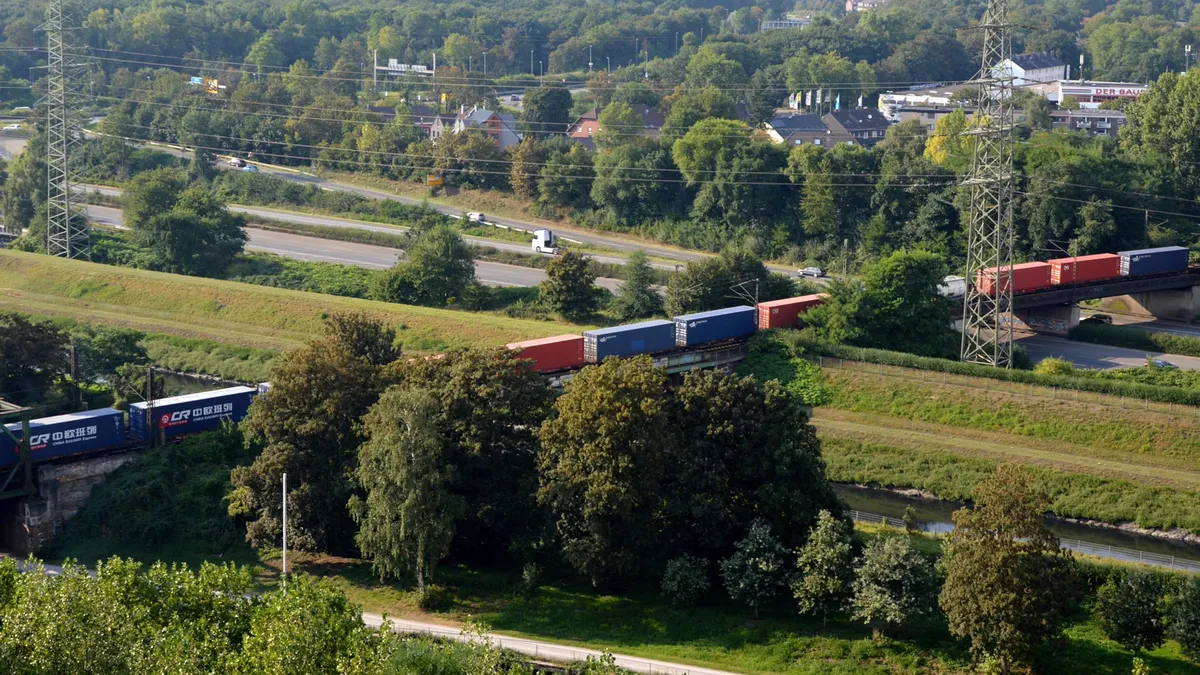
China to Germany rail freight is the only lane on this corridor where the price, the transit time and the customs treatment all change depending on a decision you make at booking: which border your container enters the European Union through, and therefore which tax office gets the declaration. A 40HQ that clears at Małaszewicze pays 23% Polish VAT and arrives in Munich as an intra-EU movement. The same box, moved under T1 to Duisburg and cleared there, pays 19% German import VAT. Rail is also the mode with the widest gap between the promise on the quote (15 days) and the door-to-door reality (15 to 26 days), and that gap is worth modelling before you commit a quarter of stock to it.
Everything below was checked on 12 November 2026. Rate bands come from published forwarder quotation data and the Index1520 market monitor, transit strings from the operator timetables, punctuality from Deutsche Bahn’s own interim report, and the customs position from EU and German statute as it now stands.
What rail freight DDP from China to Germany actually is
A block train leaves a Chinese inland terminal, crosses into Kazakhstan at Alashankou or Khorgos, runs through Russia and Belarus, changes from 1,520 mm to 1,435 mm gauge at Brest on the Belarusian side of the Bug and Małaszewicze on the Polish side, and continues on European track to a German terminal. Duisburg takes about 30% of all China to Europe rail volume and roughly 80% of China to Germany rail traffic, which is why almost every China rail quote you receive names Duisburg. Hamburg is the second German gateway. Rotterdam, Tilburg, Łódź and Warsaw absorb the rest.
There are three corridors and they are not interchangeable:
| Corridor | Route | Share of China-Europe rail | What it costs you |
|---|---|---|---|
| Northern | China, Kazakhstan, Russia, Belarus, Poland, Germany | About 70% of volume, and 85 to 90% of trains enter the EU at Małaszewicze | Fastest and cheapest, and the one exposed to every Polish border decision |
| Middle | China, Kazakhstan, Caspian Sea, Azerbaijan, Georgia, Turkey, then Europe | Small, growing since 2022 | 8 to 14 days slower, more handling, fewer slots, higher price |
| Southern | China, Kyrgyzstan, Uzbekistan, Turkmenistan, Iran, Turkey | Development stage, limited regular service | Little scheduled capacity to book |
The northern corridor is the product. The other two are insurance, and EUR 10 billion of EU money has not turned the Middle Corridor into a substitute for one crossing point.
Volume has been shrinking with the route open. EU trade with China carried by rail fell from EUR 32.4 billion in 2021, 4.7% of bilateral trade, to EUR 17 billion in 2025, or 2.2%. The risk premium, not the infrastructure, is what pushed boxes back to sea.
What a rail container costs in the fourth quarter of 2026
All figures below are door-to-door to a German address, excluding duty and VAT. Two market readings disagree and both are honest: forwarder quotation data puts a 40HQ on the commercial slot at USD 7,000 to 8,300, while the Index1520 market monitor recorded an October average of about USD 10,300 per FEU on a carrier-owned container basis. The difference is what each figure includes, so ask your forwarder which basis a number sits on before comparing it with another.
| Service | Q4 2026 | What is inside the number |
|---|---|---|
| 40HQ, commercial slot | USD 7,000 to 8,300 | Rail freight, two gauge changes, terminal handling at both ends, German trucking |
| 40HQ, fixed-timetable slot | USD 8,200 to 9,600 | Same, plus a booked slot with a contractual transit commitment |
| 20GP, either string | USD 5,400 to 7,200 | Fixed costs do not halve with a smaller box |
| LCL, per CBM | USD 250 to 380, minimum 2 CBM | Consolidated at a Chinese rail terminal, deconsolidated at a German CFS |
| Fixed-timetable surcharge | USD 400 to 700 per container | The premium for a guaranteed slot |
| Class 9 dangerous goods surcharge | USD 300 to 500 per container | Operator DG acceptance and documentation |
Two structural points sit behind that table. Rail is roughly 1.4 to 1.8 times the price of sea on the same container, and it buys 12 to 20 days. And the express premium is smaller than most buyers expect, 5% to 8% of the container rate, which is why the fixed-timetable slot is usually worth taking on anything date-sensitive.
The 15 to 20 day clock, stage by stage
The 15 to 20 day figure our Germany route page publishes is the express string. This is what it is made of.
| Stage | Express string | Commercial slot |
|---|---|---|
| Booking, slot confirmation, container release | 1 to 2 days | 2 to 5 days |
| Factory pickup, export declaration, terminal ingate | 1 to 2 days | 2 to 3 days |
| Alashankou or Khorgos border, gauge transfer to 1,520 mm | 1 to 2 days | 2 to 4 days |
| Kazakhstan, Russia, Belarus transit | 7 to 9 days | 8 to 11 days |
| Brest to Małaszewicze, gauge transfer to 1,435 mm | 1 to 2 days | 2 to 6 days |
| Poland to Duisburg or Hamburg | 1 to 2 days | 1 to 2 days |
| Terminal handling, import declaration, release | 1 to 2 days | 1 to 3 days |
| Trucking to the German address | 1 to 2 days | 1 to 2 days |
| Door to door | 15 to 20 days | 20 to 26 days |
The two strings differ by more than queueing. The express product is a published timetable with a slot you hold, and when a train misses it the operator answers for it. The commercial slot is capacity sold when it exists, and in the fourth quarter it often does not exist on the week you want.
One number belongs next to any rail promise. DB Cargo Germany ran 64.5% of its trains on time in the first half of 2026, against 67.7% for 2025 as a whole, on Deutsche Bahn’s own definition. The German network has been carrying record construction volumes, a severe winter and a June heat wave in the same half year. A rail plan that assumes a perfect German inland leg is a plan that has not read the operator’s own report.
Where the train changes gauge, and where the days go missing
Two transfers decide your transit time, and neither is a customs event.
Alashankou and Khorgos, China to Kazakhstan. The container is lifted from standard gauge onto 1,520 mm wagons. This is a terminal operation, and it is usually one to two days. It becomes longer when Chinese terminals are backloaded and trains queue at the border.
Brest and Małaszewicze, Belarus to Poland. The same lift in reverse, across the Bug. In a normal week one to three days. In September 2025 Poland closed its border with Belarus for thirteen days after the Zapad exercise, more than 130 trains were reported stranded on the Belarusian side, and the queue took weeks to clear after the crossings reopened on 25 September. Polish capacity at Małaszewicze has been declining for years, from about 21 trains a day in early 2025, and the terminals at both ends run near their design limits.
Two things have not closed the route. The EU sanctions packages restrict listed goods and have frozen the assets of Russian Railways’ director general, most recently under the 21st package in July 2026, while explicitly exempting rail freight moving between Russia and the EU. Chinese-origin goods can therefore still transit Russia legally. What changed after 2022 is not the law but the paperwork: insurers, banks and compliance departments now price the route as a risk, and a shipper whose goods contain Russian inputs has a separate problem to solve.
Where your container clears decides 23% or 19%
This is the section that separates a rail DDP quote that works from one that is a surprise invoice.
A container arriving at Małaszewicze is not yet in free circulation. Three structures are used:
Cleared at entry, in Poland. The declaration is made at Małaszewicze or another Polish customs office. Duty is paid there and Polish VAT at 23% is charged. The goods are then in free circulation in the Union and travel to Germany as an intra-EU movement with no further customs formality. This is the cheapest structure to operate and it is what most low quotes do. Its cost is the 23% instead of 19%, and a Polish VAT registration or a fiscal representative for whoever is the importer of record.
Moved under T1 to Germany, cleared there. The container travels under external transit to a German customs office, usually at the Duisburg or Hamburg terminal, and the import declaration is made in Germany under ATLAS. Duty and 19% German import VAT are charged. This is the structure a German company with a German VAT number wants, because the VAT is deductible.
Bonded storage, declaration later. Goods wait in a customs warehouse until the buyer decides where they will be sold. Useful across several countries, and it adds storage cost and a second set of deadlines.
Whose name is on the declaration decides who can deduct. If the buyer holds the EORI and the forwarder declares as direct representative, the buyer is the debtor, receives the German assessment and deducts the 19% as input tax under §15(1) UStG. If the forwarder or the seller imports under its own EORI, the onward supply becomes a domestic German supply under §3(8) UStG and the buyer cannot deduct the import VAT even when it is recharged. On the furniture example below, that difference is EUR 11,618 of working capital becoming EUR 11,618 of cost.
Timing can be softened. With a deferment account, deferred import VAT falls due on the 26th of the second month after the month of import under §21(3a) UStG. A genuine offsetting model, where import VAT is declared and deducted in the same return, was agreed by the state finance ministers for 1 January 2030 and is still waiting for legislation. One warning belongs here too: import VAT is an import duty in the criminal-law sense, undervaluation is prosecutable under §370 AO, and customs can reopen an assessment for three years, five where the error was reckless and ten where it was evasion.
For the wider German compliance picture, the customs clearance page covers the documents and registers, and the air freight guide to Germany works the same VAT logic per kilo if air is the alternative you are weighing.
What the Małaszewicze customs claims mean for a DDP booking
Through 2026 Polish customs authorities have been pursuing European logistics companies for duty, VAT, anti-dumping duty and interest on Chinese imports declared between 2021 and 2026, including rail shipments that entered at Małaszewicze. The pattern in the cases is similar: an importer declared goods under a tariff heading that carried less duty, for instance electric bicycles entered as fitness equipment to avoid anti-dumping duty, then proved insolvent or could not be found. Claims were then directed at the parties still standing, which means forwarders, rail operators, customs agents, transit operators and warehouse keepers.
The sums are in the hundreds of millions of euros, and on 30 October 2026 the Polish rail regulator UTK warned that joint liability for customs debt could push Polish operators into insolvency. CLECAT, FIATA, CER and UIRR have asked the European Commission to clarify whether operators can be held liable for fraud they had no practical way to detect, noting that a forwarder cannot open a sealed container and inspect it.
What this means for a buyer, and what to ask before you book:
- Is your forwarder the importer of record, and if so on whose EORI, and does that structure survive a claim two years later?
- Does the invoice show a correct HS code per line, with the description that goes with it? The fraud cases turn on classification, not on freight.
- Is anti-dumping duty excluded in writing from the rate you were quoted? E-bikes, ceramics, solar glass and some steel products carry it on top of MFN.
- Is the valuation the real invoice value? A rail rate that sits below cost plus duty plus VAT is a valuation that will be tested later, after the goods are sold.
A DDP price that looks 8% cheaper than the market on this corridor is usually not a cheaper train. It is a different declaration.
Rail LCL, and the volume at which a 40HQ wins
Rail LCL is real, scheduled, and cheaper per cubic metre than air by a wide margin. It is also not a small-shipment product. Groupage minimums sit at 2 to 3 CBM, which at e-commerce density is 300 to 450 kg, so the 45 kg floor we work to has no practical meaning on this mode. Below 2 CBM, sea LCL or air is the answer.
Pricing follows the same logic as sea: chargeable volume or weight, whichever is greater, with a W/M rule that usually means one cubic metre or 1,000 kg. Fixed charges at both ends, CFS handling in China and deconsolidation in Germany, do not scale with volume, which is why the per-CBM price on 2 CBM is always worse than the per-CBM price on 12.
| Volume | Cheapest rail option | Note |
|---|---|---|
| Under 2 CBM | Not available | Use sea LCL or air |
| 2 to 26 CBM | Rail LCL | At USD 310 per CBM against USD 8,200 for a 40HQ, the crossover is about 26 CBM |
| 26 to 31 CBM | Compare both | LCL still works and is more flexible on dates |
| Above 31 CBM | 40HQ | At USD 9,600 for a fixed-timetable box the crossover moves to 31 CBM |
| Near 68 CBM | 40HQ, bought for capacity | The last 30 CBM cost almost nothing on a per-unit basis |
Between 26 and 31 CBM the decision is not really about price. A 40HQ gives you a sealed box that nobody else’s cargo shares, no CFS handling at either end, and a departure on your date rather than on the consolidator’s.
Three shipments, costed end to end
Freight at the Q4 2026 bands, insurance at 0.35% of goods value, duty at the MFN rate from the Common Customs Tariff, VAT at 19% on the duty-inclusive value, converted at EUR 1 = USD 1.12. Figures are rounded to the cent and the columns add.
Shipment A: 2.4 CBM of industrial components, 380 kg, invoice EUR 11,500, HS 8483 at 1.7%.
| Line | Amount |
|---|---|
| Rail LCL, 2.4 CBM at USD 310 | EUR 664.29 |
| Cargo insurance | EUR 40.25 |
| Duty at 1.7% on EUR 12,204.54 | EUR 207.48 |
| Import VAT at 19% on EUR 12,412.02 | EUR 2,358.28 |
| Total charged at import | EUR 3,270.30 |
| Net cost if the buyer is importer of record | EUR 912.02 |
Freight is 12% of what the buyer pays at the border. This is the profile where DDP earns its margin: two and a half cubic metres, one invoice, no EORI of your own.
Shipment B: 1x40HQ of furniture, 46 CBM used, 6,800 kg, invoice EUR 52,000, HS 9403 at 3.7%.
| Line | Amount |
|---|---|
| Rail FCL 40HQ, commercial slot at USD 7,600 | EUR 6,785.71 |
| Cargo insurance | EUR 182.00 |
| Duty at 3.7% on EUR 58,967.71 | EUR 2,181.81 |
| Import VAT at 19% on EUR 61,149.52 | EUR 11,618.41 |
| Total charged at import | EUR 20,767.93 |
| Net cost if the buyer is importer of record | EUR 9,149.52 |
Net cost is EUR 1.35 per kilo on a German door. Freight is EUR 147.52 per cubic metre used. Against a sea 40HQ at the top of our published band, USD 5,900, rail is about EUR 1,520 more and takes 12 to 18 days off the journey. Against the bottom of that band it is about EUR 2,770 more, which is the honest version of the comparison.
Shipment C: 300 kg of machinery parts, 1.6 CBM, invoice EUR 7,400, HS 8483 at 1.7%.
| Line | Rail LCL | Air, 300 kg at EUR 6.05 |
|---|---|---|
| Freight | EUR 442.86 | EUR 1,815.00 |
| Cargo insurance | EUR 25.90 | EUR 25.90 |
| Duty at 1.7% on EUR 7,868.76 and EUR 9,240.90 | EUR 133.77 | EUR 157.10 |
| Import VAT at 19% | EUR 1,520.48 | EUR 1,785.62 |
| Total charged at import | EUR 2,123.01 | EUR 3,783.62 |
| Net cost if the buyer is importer of record | EUR 602.53 | EUR 1,998.00 |
Rail freight is a quarter of the air freight on this shipment, and even the total charged at the border is 56% of the air number. The cost of the choice is about eight days. The air duty line is higher only because air freight is inside the EU customs value and the VAT is charged on that.
What cannot travel by rail
Rail carries dangerous goods under RID, and acceptance is decided by the operator’s published list rather than by a general rule. DB Cargo’s Rail Cargo Operator subsidiary runs one of the broader acceptance lists in Europe, and the 2025 RID amendment added UN 3551 and 3552 for sodium-ion batteries.
The usual refusals on this corridor:
- Standalone lithium cells, UN3480. Groupage almost never takes them. Batteries packed with or inside equipment, UN3481, move with a shipper’s declaration, a UN38.3 test summary and the state-of-charge limits that apply from 2026.
- Temperature-controlled cargo. Rail wagons are not reefer equipment. Pharma and chilled food do not go this way.
- Oversize and out of gauge. Flat wagons exist, but booking one is a different product with a different price and no weekly slot.
- Cargo whose documents do not match the box. A rail operator accepting a sealed container still checks the declaration, and a mismatch stops the train at the border rather than at your door.
Magnets, motors, liquids and aerosols are accepted more readily by rail than by air, which is one practical reason a supplier who cannot fly a product can still rail it.
Rail against sea and air on the same shipment
A 900 kg, 5.2 CBM shipment of machinery parts, invoice EUR 18,000, priced in late 2026.
| Mode | Priced on | Freight | Door to door |
|---|---|---|---|
| Air under DDP | 900 kg chargeable at EUR 6.05 | EUR 5,445.00 | 5 to 8 days |
| Rail LCL under DDP | 5.2 CBM at USD 310 | EUR 1,439.29 | 15 to 20 days |
| Sea LCL under DDP | 5.2 CBM at USD 185 | EUR 858.93 | 30 to 42 days |
| Sea FCL under DDP | 40HQ at USD 5,400 | EUR 4,821.43 | 28 to 40 days |
Rail sits at 26% of air on this profile and 68% above sea LCL. The break-even is arithmetic: the rail premium over sea LCL here is EUR 580, bought with 15 to 20 days of earlier availability. If those days are worth more than about EUR 39 a day to you, rail wins. On fast-moving consumer stock they usually are. On a container of tiles they are not.
The volumes where rail loses to sea on price alone are large ones: at full container load, sea is 1.4 to 1.8 times cheaper and that premium buys 12 to 20 days, not a different service. Rail wins on dated arrivals, on inland Chinese origin points where the truck to a seaport costs a week, and on anything where a stock-out is more expensive than the freight.
The booking calendar that decides your arrival date
Three dates on the calendar outrank any quote.
Chinese New Year falls on 6 February 2027, with the official holiday running 5 to 13 February. Rail capacity leaves China three to four weeks before that. Anything that must be on a German shelf before the holiday needs to be on a train in the first week of January.
Germany bans trucks over 7.5 tonnes from 00:00 to 22:00 on Sundays and public holidays under §30 StVO, with additional Saturday restrictions on listed routes in summer. A container released at Duisburg on a Saturday morning does not reach a Bavarian address until Monday night. Thursday and Friday releases are worth chasing for that reason alone.
Polish border incidents are political, not logistic. The September 2025 closure began with a military exercise and ended with a political decision. Build two weeks of float into anything date-critical.
Nine questions that separate two rail DDP quotes
- Is this a fixed-timetable slot or commercial capacity, and what happens to my transit commitment if the train is cancelled?
- Which border does the declaration name, Poland or Germany, and at which VAT rate is the import charged?
- Whose EORI is on the import declaration, and can I deduct the VAT that is charged?
- Is the rate per container or per chargeable tonne and cubic metre, and with what W/M rule?
- Is anti-dumping duty excluded in writing?
- What is the door-to-door transit time, and how many of those days are Polish border and terminal queueing?
- What is excluded: storage after free time, DG surcharges, out-of-hours delivery, returns?
- Which German terminal, and does the rate hold for a delivery outside that terminal’s natural catchment?
- What is the fallback if Małaszewicze closes for a week, and who pays for the delay?
A forwarder who answers all nine in writing has priced the shipment. A forwarder who answers three and moves to the next has priced a train.
FAQ
How much does rail freight DDP from China to Germany cost? Door-to-door and excluding duty and VAT, about USD 7,000 to 8,300 for a 40HQ on commercial capacity and USD 8,200 to 9,600 for a fixed-timetable slot in Q4 2026, or USD 250 to 380 per CBM by rail LCL with a 2 CBM minimum. Add duty at your HS code and 19% import VAT if the goods clear in Germany.
How long does rail freight from China to Germany take door to door? 15 to 20 days on the express string our route page quotes, and 20 to 26 days on commercial capacity. The train itself is roughly 12 days from Xi’an to Duisburg; the rest is booking, terminal handling, two gauge changes and the German delivery leg.
Where does a rail shipment from China to Germany clear customs? It can clear at entry in Poland, in which case Polish VAT at 23% is charged, or move under T1 to a German terminal and clear there, in which case German import VAT at 19% applies. Which one happens decides whether your business can deduct the VAT, so ask before booking rather than after.
Can I deduct the import VAT on a rail DDP shipment? Only if you are the importer the goods were brought in for. In practice that means holding the EORI and being named on the assessment. If the forwarder or seller imports under its own EORI, the onward sale is a domestic German supply under §3(8) UStG and the VAT cannot be deducted, even where it is recharged to you.
What is the minimum shipment size by rail? Rail LCL groupage starts at 2 to 3 CBM, which is 300 to 450 kg at typical e-commerce density. Below that, sea LCL or air is the only option. Our own floor is 45 kg for air and courier, but it does not apply to rail because the mode does not sell that small.
Can batteries go by rail from China to Germany? Batteries inside or packed with equipment, UN3481, usually can, with a declaration, a UN38.3 summary and state-of-charge limits. Standalone lithium cells, UN3480, are refused by most groupage services. Sodium-ion cells were given their own UN numbers, 3551 and 3552, in the 2025 RID amendment.
What happens if the Polish border closes again? Trains queue on the Belarusian side and the transit promise stretches by days or weeks. The alternatives are the Middle Corridor through the Caspian, which is slower and costlier with fewer slots, or switching modes. Ask your forwarder what their fallback is and who absorbs the delay before you book, because after the closure the answer is whoever signed the contract.
Getting a rail quote that survives the invoice
Rail into Germany is priced by three things you control: the container or the cubic metres, the string you book, and where the declaration is made. The first two are freight mechanics. The third decides whether 19% of your landed value is working capital or a cost, and it is the one line most quotes leave blank.
Send us the CBM, the weight, the HS code and the destination postcode, and say whether you want the declaration made in Germany. We will price rail against sea and air on the same shipment and name the importer of record in writing. If LCL is the better answer, the LCL guide to Germany explains what a per-CBM quote includes. If your volumes are large enough that sea wins on price, the FCL sea freight guide works the same VAT logic on containers, and DDP versus DAP covers the term comparison when a supplier proposes something else.