
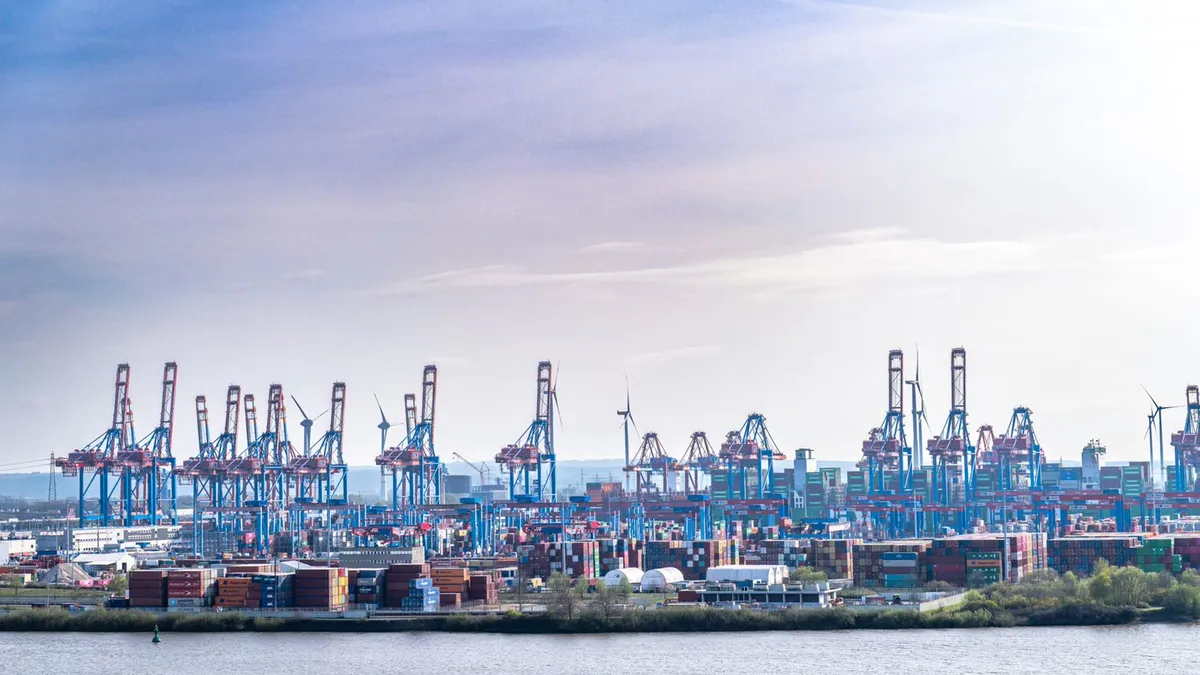
Shipping from China to Hamburg is the cheapest way into Europe by sea and the most complicated way to get a box off the quay: one port, four container terminals, roughly 200 freight trains a working day, and a terminal productivity problem in 2026 that a vessel schedule will not show you. Hamburg moved 8.3 million TEU in 2025, 7.3% more than the year before, then handled 6.1 million TEU in the first nine months of 2026, 2.8% below the same period last year, while trade with China was almost flat at minus 0.6%.
Everything below was checked on 14 November 2026. Port and throughput figures come from the Hamburg Port Authority and HHLA reporting, rate lines from Drewry’s World Container Index and carrier local-charge tariffs, and the duty and VAT position from German customs practice and the EU tariff.
What Hamburg is as a freight gateway in 2026
Germany’s largest seaport handled 114.6 million tonnes in 2025, up 2.6%, and 8.3 million TEU, up 7.3% on 2024. The growth came from China (up 6.5%), Malaysia (up 84.3%) and India (up 49.2%). Traffic with the United States fell 25.6% as the tariffs bit. For a Chinese exporter, that mix matters: Hamburg is still the port where your competitor’s cargo goes.
The first nine months of 2026 ran the other way. Total cargo was 84.5 million tonnes, down 2.6%, and containers were 6.1 million TEU, down 2.8%. The port authority attributes the decline to weather losses at the start of the year, disruption in the oil market after the war in Iran, strikes, and the modernisation works at the container terminals. China volume was close to flat at minus 0.6%, so the missing boxes were not Chinese.
What sits behind those numbers is the part that decides your delivery date.
- Rail is not a side business here. Around half of all hinterland containers leave or reach Hamburg by train, about 2.6 million TEU and 44 million tonnes a year. HHLA, which runs three of the four terminals, states that more goods move by rail in Hamburg than in Rotterdam and Antwerp combined.
- The rail machine is large and fixed. Roughly 200 freight trains arrive or depart every working day, and the port railway has limited paths in a way the road network does not. A missed slot costs a day or three, not an hour.
- Terminal choice is a real choice. The four terminals are run by two companies with different equipment, different costs and different rail connections, and your bill of lading names one of them.
How long shipping from China to Hamburg takes
Two numbers get confused in every quote: the water leg and the door-to-door window. On a direct string the water leg from Shanghai is 26 to 30 days through Suez, and door to door on the same string is 28 to 33 days, because the last two days are terminal release and trucking rather than sailing.
| Mode | Door to door, Germany | Best for |
|---|---|---|
| Air freight DDP | 4 to 8 days | 45 kg to 1 tonne, launch stock, a line-down part |
| Rail, China-Europe Railway Express | 15 to 20 days | 2 CBM and up, dated delivery without air rates |
| Rail, commercial slot | 20 to 26 days | Volume cargo that can absorb a week of slack |
| Sea LCL DDP | 30 to 42 days | 1 to 15 CBM |
| Sea FCL, fast direct string | 28 to 33 days | 15 CBM and up, a predictable berth window |
| Sea FCL, standard string | 33 to 40 days | 15 CBM and up, date flexibility |
Port pair by port pair, the sea numbers move less than the door numbers:
| Lane | Port to port | Door to door, fast | Door to door, standard |
|---|---|---|---|
| Shanghai to Hamburg | 26 to 30 days | 28 to 33 days | 33 to 40 days |
| Ningbo to Hamburg | 27 to 31 days | 29 to 34 days | 34 to 41 days |
| Yantian or Shekou to Hamburg | 28 to 33 days | 30 to 36 days | 35 to 42 days |
| Qingdao to Hamburg | 30 to 35 days | 32 to 38 days | 37 to 44 days |
One thing is changing under those ranges. Most Asia to North Europe services spent 2026 routing around the Cape of Good Hope, which added roughly 10 to 12 days to a round voyage. The return to Suez began in October 2026, with the first Suez arrivals in Europe due in late November, and analysts expect published Asia to North Europe schedules to show 7 to 10 days shaved off through the first quarter of 2027. If that holds, the fast band above gets shorter. Do not plan a March shipment on it until the carrier publishes the new string.
The four terminals, and which one your box lands at
A booking that says “Hamburg” names a port, not a terminal, and the terminal decides your cost and your rail slot.
| Terminal | Operator | Where | Rail on dock | What it changes for you |
|---|---|---|---|---|
| CTA, Altenwerder | HHLA | South of the Elbe | Yes, automated | Fully automated yard, the most consistent gate times, popular with alliance megaship strings |
| CTB, Burchardkai | HHLA | Waltershof | Yes | The largest terminal by area, mixed equipment, most feeder and relay traffic |
| CTT, Tollerort | HHLA | Waltershof | Yes | Smaller, closer to the city side, where MSC’s 49.9% stake in HHLA lands |
| CTH | Eurogate | Waltershof | Yes | The non-HHLA option, and the cheaper published handling charge |
Published terminal handling is not the same at all four. In the carrier local-charge tariffs valid from 1 January 2026, HHLA terminals quote EUR 216.70 per 20ft and per 40ft, while Eurogate Hamburg quotes EUR 145.00. That EUR 71.70 gap is not something an importer usually sees, because it sits inside the ocean freight or the DDP rate, but it explains why two forwarders quote the same sailing differently.
Cheaper handling is not automatically the better terminal. A terminal with one rail departure a day to your region can cost you two days against a terminal that charges more and has three. Ask which terminal the box is booked to, and which rail ramp it leaves from.
Why a 2026 Hamburg box runs late when the ship is on time
The usual suspect is congestion. Hamburg is not congested in the anchorage sense: in the week to 8 November 2026 the median vessel waiting time was 0.04 days. Ships are berthing on arrival.
The delay has moved inland, to terminal productivity.
- Automation ramp-up. HHLA is converting more of its Hamburg yard operations to automated equipment, and the ramp-up phase has cost throughput and gate performance through 2026. The company’s own nine-month statement names it, alongside strike disruption, as the reason its Hamburg terminals handled 4.2 million TEU, down 7.7%, and why the container segment’s operating result fell 51.3% to EUR 29.4 million. Group operating result fell 30.7% to EUR 81.2 million and the 2026 forecast was cut to EUR 115 million to 135 million.
- Strikes. Dockworkers walked out in a 48-hour warning strike from Wednesday 2 September 2026, after a one-day warning strike that hit Hamburg and Bremerhaven among six German ports. The dispute covers about 11,000 employees and is not settled in a way that makes a 2027 strike unlikely.
- Storage is being charged more, not less. HHLA’s nine-month statement notes that additional storage fees at the Hamburg container terminals only partly offset the lost volume. A box that sits because the yard cannot work it is a box that accrues charges.
- Exams compete for the same slots. A customs inspection at the terminal takes a yard slot and a crane move. When the yard is behind, the exam queue is behind with it.
What that means for a booking: ask for the terminal release date separately from the vessel ETA, and ask when the container is loaded on rail. Those two dates, not the sailing, are where a Hamburg delivery slips. Our rail guide to Germany covers the same failure pattern on the overland route, where a border queue plays the role the terminal yard plays here.
What the Elbe depth change does from 17 November 2026
The Elbe is the reason Hamburg is not Rotterdam. Ships have to come up a river, and the river’s depth decides how much they can load for a Hamburg call and whether they have to wait for the tide.
The channel between Cuxhaven and Hamburg was dredged between July 2019 and March 2021. Authorities declared the project complete in early 2022, restricted its use in summer 2023 after unexploded ordnance and sediment were found, and the promised depth for large tide-dependent ships was never quite reached, by 20 cm according to the city’s economic department. From 17 November 2026, the waterways authority allows container ships drawing up to 13.8 metres to sail that stretch regardless of the tide.
The practical effects:
- Fewer tide windows. A vessel that had to sail on a tide can now keep its schedule, which is the difference between a Thursday arrival and a Saturday one on a tight berth plan.
- Bigger call sizes become economic. A deeper draft means more boxes per call, and larger calls are exactly what a four-terminal port with limited rail paths handles worst.
- It does not make the terminal faster. Draft was never the bottleneck in 2026. Terminal productivity was, and that is unaffected.
For an importer, the Elbe matters as a schedule-reliability signal rather than a rate line. A carrier that can discharge a full call without tide arithmetic is a carrier whose weekly service is less likely to be reshuffled at the last minute.
Hamburg, Bremerhaven or Duisburg: the routing decision
Three ports and one rail gateway compete for the same container, and the right answer depends on where the consignee is rather than on the ocean rate.
| Gateway | How the cargo moves | Door-to-door band | When it wins |
|---|---|---|---|
| Hamburg | Sea, then truck or rail | 28 to 40 days | Northern and eastern Germany, Poland and the Czech border regions, rail connections south |
| Bremerhaven | Sea, then truck or rail | 28 to 35 days | Alliance strings that call Bremerhaven first, north-west Germany, the Netherlands border |
| Duisburg | Rail only, no sea call | 15 to 20 days by rail | Western Germany, Belgium, the Rhine corridor, and any shipment bought on transit time |
| Rotterdam or Antwerp plus a T1 to a German inland office | Sea, then transit to Germany | 28 to 42 days | Western Germany when the Dutch gateway is cheaper per CBM |
The choice between Hamburg and Bremerhaven is mostly made for you by the carrier’s rotation. The choice between sea and rail is yours, and it is a price decision: rail to Duisburg at EUR 7,000 to 8,300 per 40HQ on a commercial slot against a sea 40HQ at USD 5,400 to 5,900 door to door, for 12 to 18 days less transit. The arithmetic and the break-even volumes are in the Germany rail guide.
What German customs charges at Hamburg
The German customs value is the CIF value: goods, plus freight to the German border, plus insurance. That is the opposite of Canada, where freight is outside the duty base, and it means your ocean freight attracts duty here.
| Line | Base | Rate |
|---|---|---|
| Customs duty | CIF value | 0% to 17%, by HS code |
| Import VAT (Einfuhrumsatzsteuer) | CIF value plus duty | 19% |
| Anti-dumping duty, if the product is under a measure | CIF value | Case by case, per product and exporter |
| CBAM certificate cost, if the goods are on the CBAM list | Embedded emissions | 2026 scheme, separate from duty |
Three mechanics sit on top of the rates.
EORI. The importer needs an EU EORI number, and the declaration has to be lodged in ATLAS, the German customs system. A DDP service that uses the forwarder’s own EORI produces a legally different transaction from one where your company is the declarant, and the difference shows up in the VAT line.
ICS2. Since 1 June 2026 every consignment entering the EU by any mode of transport needs a valid Entry Summary Declaration in ICS2 before loading. A missing or mismatched ENS stops the cargo before it is allowed on the vessel, which is a failure mode that does not appear on a freight quote.
CBAM. Steel, aluminium, cement, fertiliser, electricity and hydrogen are inside the carbon border mechanism, and since 1 January 2026 the goods can only be imported by an authorised CBAM declarant. If your Hamburg shipment is steel or aluminium, a DDP price that bundles duty and VAT does not bundle CBAM certificates unless it says so in writing. For the rest of the cargo on this lane, electronics, furniture, apparel and toys, CBAM is not a line item.
Who is the importer of record, and where the 19% goes
Someone is named as importer on the German entry, and that entity is the debtor for duty and for the 19% import VAT.
If the importer is your German company, the VAT is input tax under section 15(1) of the German VAT Act. You pay it at the border, or defer it under the import VAT deferral procedure, and reclaim it on the return. On a EUR 57,450 shipment the 19% comes to EUR 11,319, which is working capital rather than a cost.
If the forwarder or the Chinese seller imports under its own EORI, the onward supply is a domestic German supply under section 3(8) of the VAT Act, and the VAT you pay is not deductible by you even when it is invoiced. That is the single most expensive misunderstanding in the German DDP market, and the air freight guide to Germany works through the costs of both structures on one shipment.
The EUR 3 duty and the EUR 2 fee do not touch a consolidated container
Two European charges introduced in 2026 are quoted by competitors as if they apply to everything. They do not.
Since 1 July 2026 the EUR 150 duty relief is gone and a temporary duty of EUR 3 per item applies to consignments sold in distance sales with an intrinsic value up to EUR 150, until 1 July 2028. Since 1 November 2026 a EUR 2 Union handling fee applies to those same low-value consignments.
A commercial LCL or FCL shipment to a German company on a commercial invoice is not a distance sale and pays neither. It pays ordinary duty at its HS rate and 19% VAT. The full timeline and the platform liability change are in the November 2026 freight news post, and the parcel versus consolidated distinction is the part worth reading twice.
From the terminal to your customer
Hamburg’s advantage is that the terminal is 20 minutes from a rail yard and an hour from a large trucking pool, and the disadvantage is that both are booked in advance.
- Direct truck. The right answer for a Hamburg, Bremen or Hannover address. Terminal to a north German warehouse is usually a same-day or next-day move once the container is released and the truck has a slot.
- Rail to the hinterland. For Munich, Stuttgart, Frankfurt, Leipzig or Basel, rail is usually faster and cheaper than trucking, because the port railway is doing the long haul on a fixed schedule. It also means the container has to be released before the train’s cut-off, not before your delivery date.
- Transload. For 53-foot domestic distribution or multi-SKU e-commerce, deconsolidation near the port is cheaper than moving a 40HQ inland and handling it twice.
- Amazon FBA and 3PL. German fulfilment centres want a booked appointment, and the appointment is not the container’s arrival. A box that arrives early sits at the terminal and rents yard space. Our Amazon FBA page covers the label and appointment mechanics.
Budget for storage. HHLA’s own reporting shows additional storage fees at Hamburg terminals, and a container waiting on a rail slot or an appointment is exactly the box that pays them.
What Hamburg will not accept
Customs clears goods, and German regulators check other things before and after release.
- Dangerous goods. IMDG by sea, RID by rail, a separate acceptance process for lithium batteries with a UN38.3 summary and, from 2026, the state-of-charge limit on air shipments.
- CE marking and product rules. Electrical goods, toys, machinery and PPE have conformity requirements that customs may ask for, and the EU market surveillance authorities ask for the technical file after the goods are sold.
- Packaging registration. The EU Packaging and Packaging Waste Regulation applies from 12 August 2026 and Germany’s Verpackungsgesetz requires LUCID registration before goods are placed on the market. A missing registration is a sales problem that becomes a delivery problem.
- WEEE and batteries. Producer registration for electrical equipment and separate obligations for batteries, both checked by the authorities rather than by customs.
- Wood packaging. ISPM 15 treatment and the stamp, per pallet and per crate.
- CBAM goods. Without an authorised declarant, steel and aluminium cannot be entered at all.
None of this changes the freight rate. All of it can stop the truck.
Three shipments, costed end to end
Freight at the Q4 2026 bands, insurance at 0.35% of goods value, duty at the MFN rate from the Common Customs Tariff, VAT at 19% on the duty-inclusive value, converted at EUR 1 = USD 1.12. Figures are rounded to the cent and the columns add.
Shipment A: 1x40HQ of furniture, 46 CBM used, 6,800 kg, invoice EUR 52,000, HS 9403 at 3.7%, sea via Hamburg on a fast direct string.
| Line | Amount |
|---|---|
| Sea freight, 40HQ at USD 5,900 | EUR 5,267.86 |
| Cargo insurance at 0.35% | EUR 182.00 |
| Duty at 3.7% on the CIF value of EUR 57,449.86 | EUR 2,125.64 |
| Import VAT at 19% on EUR 59,575.50 | EUR 11,319.35 |
| Total charged at import | EUR 18,894.85 |
| Net cost if the buyer is importer of record | EUR 7,575.50 |
Net cost is EUR 1.11 per kilo and EUR 114.52 per cubic metre used. VAT is 60% of the import bill, which is why the importer question is worth more than the freight negotiation.
Shipment B: 6.5 CBM of apparel, 1,050 kg, invoice EUR 16,500, HS 61 at 12%, LCL via Hamburg.
| Line | Amount |
|---|---|
| Sea LCL, 6.5 revenue tons at USD 165 plus USD 150 fixed | EUR 1,091.52 |
| Cargo insurance at 0.35% | EUR 57.75 |
| Duty at 12% on the CIF value of EUR 17,649.27 | EUR 2,117.91 |
| Import VAT at 19% on EUR 19,767.18 | EUR 3,755.76 |
| Total charged at import | EUR 7,022.94 |
| Net cost if the buyer is importer of record | EUR 3,267.18 |
Duty is nearly twice the freight on this shipment. Apparel into Germany is a duty problem with a freight line attached, and the per-CBM rate your forwarder quoted is the smallest number in the table.
Shipment C: 420 kg of machinery parts, 2.1 CBM, invoice EUR 24,000, HS 8483 at 1.7%, air to Frankfurt with trucking to Hamburg.
| Line | Amount |
|---|---|
| Air freight, 420 kg chargeable at EUR 6.05 | EUR 2,541.00 |
| Cargo insurance at 0.35% | EUR 84.00 |
| Duty at 1.7% on the CIF value of EUR 26,625.00 | EUR 452.63 |
| Import VAT at 19% on EUR 27,077.63 | EUR 5,144.75 |
| Total charged at import | EUR 8,222.38 |
| Net cost if the buyer is importer of record | EUR 3,077.63 |
Air earns its price on the stock-out, not on the freight table: EUR 2,541 buys four days against thirty, and on a part that stops a line that trade is obviously worth it. On slow-moving stock it is a EUR 2,000 donation. The air freight guide prices the per-kilo bands these shipments sit in.
Nine questions that separate two Hamburg DDP quotes
- Which of the four terminals is the container booked to, and is the trucking priced from that terminal?
- Which rail ramp does it leave on, and what is the cut-off relative to the vessel arrival?
- Is this a fast direct string or a standard string, and what is the door-to-door window in days?
- Who is the importer of record, whose EORI is on the entry, and can I deduct the 19% import VAT?
- Is duty included at my HS code’s rate, and is any anti-dumping duty excluded in writing?
- Is CBAM in scope for my goods, and if so, who buys the certificates?
- Is the EUR 2 handling fee or the EUR 3 duty being applied to my shipment, and why?
- What is excluded: storage after free time, exam costs, FBA appointment failures, rail rebooking?
- What is the fallback if the terminal falls behind or the rail slot is lost?
A forwarder who answers all nine has priced the shipment. A forwarder who answers three has priced the sailing.
FAQ
How long does shipping from China to Hamburg take? 28 to 33 days door to door on a fast direct sea string, and 33 to 40 days on a standard string. The water leg alone is 26 to 30 days from Shanghai. Rail takes 15 to 20 days and air freight 4 to 8 days.
How much does it cost to ship a container from China to Hamburg? About USD 5,400 to 5,900 for a 40HQ and USD 2,800 to 3,800 for a 20ft, all-in door to door, excluding duty and VAT. LCL runs USD 150 to 190 per CBM at 6 to 9 CBM and USD 140 to 170 at 10 to 15 CBM. Duty depends on the HS code and import VAT is 19% on the duty-inclusive value.
Which terminal will my container arrive at in Hamburg? One of four: HHLA’s CTA at Altenwerder, CTB at Burchardkai or CTT at Tollerort, or Eurogate’s CTH at Waltershof. Published terminal handling runs EUR 216.70 per container at the HHLA terminals and EUR 145.00 at Eurogate in the 2026 carrier tariffs. Ask at booking, because the rail connection differs by terminal.
Why is my Hamburg shipment late in 2026 if the port is not congested? Vessel waiting time was about 0.04 days in early November 2026, so the ships are berthing on arrival. The delay is in terminal productivity during HHLA’s automation ramp-up and in the strike disruption of September 2026, which shows up as a later terminal release date and a later rail slot.
Does the Elbe deepening help my shipment? From 17 November 2026 container ships drawing up to 13.8 metres can sail between Cuxhaven and Hamburg regardless of the tide. That improves schedule reliability and lets carriers discharge bigger calls. It does not speed up the terminal.
Is the EUR 2 handling fee charged on my container? No. The EUR 2 Union handling fee and the EUR 3 duty apply to low-value consignments sold in distance sales to consumers. A commercial LCL or FCL shipment declared on a commercial invoice pays ordinary duty at its HS rate and 19% import VAT.
Can I reclaim the 19% German import VAT? Only if your company is the importer of record on the entry, with your own EORI. Then the VAT is input tax and you reclaim it on your return, or defer it under the import VAT deferral procedure. If a forwarder imports under its own EORI and re-invoices you, the supply is a domestic German supply and the VAT is a cost.
What is the minimum shipment size to Hamburg? 45 kg. That is our floor on every lane, and it is also where per-kilo air pricing starts to make sense. Below that, courier consolidation is cheaper than any freight product we can sell.
Getting a Hamburg quote that survives the invoice
Hamburg is priced by four things: which terminal the box is booked to, whether it moves inland by rail or truck, what the HS code says, and who is named as importer. The first two are freight. The last two decide what the border charges, and they are the two lines a cheap quote leaves vague.
Send us the delivery postcode, the CBM, the weight and the HS code. We will tell you which terminal the container is booked to, what the rail or truck leg from that terminal costs, whether Duisburg or Bremerhaven is cheaper to your address, and whose EORI will be on the entry. The DDP shipping from China to Germany page covers the lane end to end. If your volume is one or two cubic metres, the LCL guide to Germany prices the fixed costs that decide the per-CBM number, and the FCL guide does the same for a full box.