
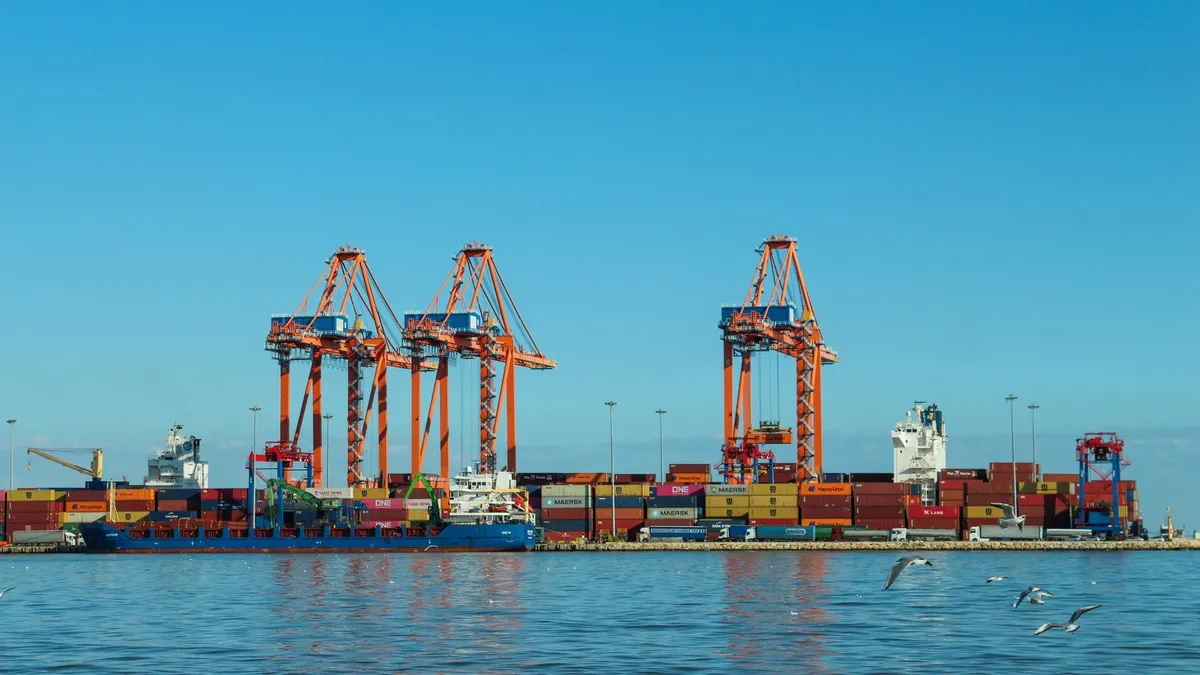
The shipping from China to London quote you receive in November 2026 is built on a port you will probably never visit, a customs entry filed in a system called CDS, and a lorry that has to obey noise rules the rest of the UK ignores. Most of the money sits in those three places, not in the ocean freight line everyone argues about.
London is also not one destination. A pallet delivery to a fulfilment centre in Tilbury, a warehouse in Park Royal and a unit in Croydon are three different jobs at three different prices. A quote that says “London” without a postcode is not a quote.
What door to door to London includes under DDP
Delivered Duty Paid means one party, usually a forwarder acting for the seller, handles the cargo until it is unloaded at the named UK address. On a China to London DDP booking that means seven legs: factory pickup in China, export declaration, main carriage by sea, air or rail, UK terminal handling and deconsolidation, HMRC entry through CDS with duty and import VAT paid or accounted for, delivery to the address, and the documents that make all of it legal, from a commercial invoice with commodity codes to an EORI on the entry.
What DDP does not automatically cover: demurrage caused by late documents, waiting time beyond the free period, a failed delivery attempt and redelivery, unpacking or placement inside a building, UKCA compliance work, duty that rises after a commodity code is reclassified post-clearance, and storage if you are not ready to receive.
There is a floor as well. We do not quote below 45 kg, roughly 0.3 CBM at e-commerce density. Under that weight the economics belong to parcel networks, and a forwarder quoting a DDP price for 10 kilos is selling an express label with a markup.
How much does shipping from China to London cost in 2026
Three numbers cover most enquiries. LCL runs about $95 to $160 per CBM on the freight and handling side, before duty and VAT. A 20ft container lands at $3,300 to $4,800 all-in with duty, a 40HQ at $5,800 to $7,500. Air sits between $4.50 and $9.00 per kilo depending on weight band and goods value.
The port-to-port market behind those figures softened through October 2026. A published index put China to UK FCL at $2,070 to $2,530 for a 20GP and $3,150 to $3,850 for a 40GP into Southampton, Felixstowe and London Gateway, down 23.1 percent month on month, with LCL at $55 per CBM and air at $4.60 per kilo. Those are terminal-to-terminal. A DDP price adds clearance, duty, delivery and margin, which is why the two sets of numbers never match and both are honest.
| Cost line | LCL, 1 to 13 CBM | FCL, 20ft or 40HQ | Air, 45 kg and above |
|---|---|---|---|
| Factory pickup and export declaration | $80 to $180 per shipment | $150 to $300 per shipment | Usually inside the per-kg rate |
| Main carriage to London | $45 to $150 per CBM | $2,070 to $3,850 per box, Oct 2026 spot | $4.60 to $6.00 per kg, Oct 2026 |
| UK terminal handling or deconsolidation | £45 to £65 per CBM | £120 to £190 per box | £0.08 to £0.15 per kg |
| CDS entry and ENS filing | £75 to £120 per entry | £75 to £120 per entry | £60 to £95 per entry |
| Duty | 0 to 17 percent of CIF | 0 to 17 percent of CIF | 0 to 17 percent of CIF |
| Import VAT | 20 percent of CIF plus duty | 20 percent of CIF plus duty | 20 percent of CIF plus duty |
| Delivery inside Greater London | £0.80 to £1.50 per kg, min £65 | £150 to £450 per box | £0.60 to £1.20 per kg |
| Door-to-door transit | 28 to 40 days | 25 to 35 days | 5 to 10 days |
One asymmetry before you compare quotes: sea freight is itemised like the table above, while air is sold as a single per-kg rate bundling clearance, duty and delivery, with VAT folded in at typical e-commerce values or billed separately on high-value cargo. A $5.50 per kg air quote and a $120 per CBM sea quote do not measure the same thing.
Which London gateway should your cargo arrive at
London overtook Felixstowe on container units in the second quarter of 2026, according to provisional Department for Transport estimates: about 504,000 units through the Port of London against 464,000 at Felixstowe, the first quarter London had led since the series began in 2018. The growth came from London Gateway, which passed three million TEU in 2025.
That helps rates, because Thames service frequency is better than it was three years ago. It also concentrates risk, because the terminal’s four berths were already running at roughly 88 percent of rated capacity in 2025. Berth five opens in 2027 and a new empty-container stack follows in 2028, so the relief arrives after this winter.
| Gateway | Where it sits | Best for | Ocean transit from Shanghai or Ningbo | What to watch |
|---|---|---|---|---|
| London Gateway, Essex | M25 junction 30, north bank of the Thames | Greater London, Essex, Kent, the South East | 24 to 29 days | Yard pressure in Q4 at a terminal running near capacity |
| London Container Terminal, Tilbury | 22 nautical miles east of central London, berths to 13.7 m, ships up to 10,000 TEU, 1,400 reefer plugs | Feeder and short-sea cargo, chilled goods, weeks when Gateway is full | 27 to 32 days including feeder | Fewer direct deep-sea calls, so often one transhipment |
| Felixstowe, Suffolk | East coast, about 90 miles from central London | East of England and the Midlands | 26 to 30 days | Two to three hours by road to London |
| Southampton, Hampshire | South coast | South West, Midlands, rail-linked inland terminals | 24 to 28 days | The wrong side of the country for a London postcode |
For an address inside the M25, London Gateway is the default and usually the cheaper option, because the haulage run is 25 to 40 miles instead of 90. Tilbury earns its place on chilled cargo and on weeks when the Gateway berths are full. Felixstowe stays right for cargo stored in the Midlands or East Anglia, Southampton only for goods heading west.
How long does shipping from China to London take
The honest answer splits into three clocks: ocean transit, door-to-door DDP, and the date a warehouse or Amazon will accept the goods. Comparing a carrier’s port-to-port figure with a forwarder’s door-to-door figure is how people end up disappointed.
| Route | Ocean transit | Door-to-door DDP |
|---|---|---|
| Shanghai to London Gateway | 24 to 28 days | 27 to 33 days |
| Ningbo to London Gateway | 25 to 29 days | 28 to 34 days |
| Yantian or Shekou to London Gateway | 25 to 29 days | 28 to 34 days |
| Qingdao to London Gateway | 27 to 31 days | 30 to 36 days |
| Shanghai to Tilbury, via feeder | 27 to 32 days | 30 to 36 days |
| Any Chinese port to London, LCL | 25 to 30 days at sea | 28 to 40 days |
| Stage | Days | What goes wrong here |
|---|---|---|
| Factory pickup, loading and VGM | 2 to 3 | Cargo not ready, or overweight against declared VGM |
| Export declaration and vessel cut-off | 1 to 2 | Commodity code disputed at origin, missed cut-off |
| Ocean leg to London Gateway | 24 to 28 | Cape of Good Hope routing adds 10 to 14 days |
| Discharge, CDS entry and release | 1 to 2 | HMRC examination adds 2 to 5 days |
| Delivery and unloading | 1 | No booking slot, lorry control timing, access refusal |
Two things move those ranges. The first is routing. After Premier Alliance services returned to the Suez Canal in October 2026, most Asia to North Europe strings are back through the canal, but some alliances still run around the Cape, and the two differ by 10 to 14 days. Ask which rotation your booking sits on instead of assuming the faster one. The second is consolidation: LCL adds two to three working days at the origin warehouse and another two to three at the UK CFS before the cargo is released.
Air runs 5 to 10 days door to door into Heathrow, with direct capacity from Shanghai, Guangzhou and Hong Kong. That is the whole advantage, a week instead of a month, at roughly six to eight times the per-kilo cost.
Why the last few miles into London cost more than the ocean leg
A 40ft container from Ningbo to London Gateway can cost less than the truck that moves it from Gateway to a basement loading bay in the City. Four rules explain most of the gap.
The London Lorry Control Scheme. Vehicles over 18 tonnes are restricted on designated roads from 21:00 to 07:00 Monday to Friday, and from 13:00 Saturday to 07:00 Monday. Hauliers buy a permit through London Councils, use the Excluded Route Network, or deliver inside the permitted hours. Since the 2025 amendment, zero-emission two-axle vehicles up to 20 tonnes are exempt, which is one reason electric 18-tonners are appearing on London lanes.
The Direct Vision Standard. Any HGV over 12 tonnes needs an HGV safety permit to operate in Greater London, and since October 2024 the permit requires the Progressive Safe System of cameras, sensors and side-scan warnings. A haulier without the permit cannot take your delivery at any price, so the pool of trucks serving central postcodes is smaller than the national pool.
Charging zones. The Congestion Charge is £18 a day if paid on the day or in advance, £21 if paid later, and the Ultra Low Emission Zone charges £12.50 a day for non-compliant vehicles. Those costs are absorbed into the delivery rate, which is why a box into WC2 or EC2 is priced apart from one into RM or DA.
Physical access. Central London windows are often 07:00 to 16:00 with two-hour booking slots. Parking suspensions are arranged in advance, some loading bays cannot take a 7.5-tonne truck, and residential blocks need a named contact who will open the door. A failed attempt sends the goods back to the depot and the redelivery is chargeable.
Send five things and the last-mile price stops moving: full postcode, access type (yard, loading bay, lift, stairs), the delivery window the site accepts, whether tail-lift or pallet truck is needed, and whether the street is on a red route or inside the charging zone.
What HMRC wants before the vessel berths
A GB EORI number. Every UK importer needs one, GB plus twelve digits. An EU EORI has not been valid in Great Britain since January 2021, and a broker cannot file an entry without one.
An entry through CDS. Import declarations moved to the Customs Declaration Service and CHIEF was closed for imports, so a broker or the forwarder files electronically. Under DDP the forwarder usually files in its own name, which has consequences covered below.
An ENS 72 hours before departure. The Entry Summary Declaration carries safety and security data for the sea leg. Miss the window and the carrier can refuse to load.
A commodity code that survives scrutiny. Ten digits, and the UK Global Tariff rate that follows decides your duty. Classification is also the most common source of a post-clearance bill, because HMRC can reclassify after release and recover the difference.
Import VAT, paid or postponed. Standard rate is 20 percent on CIF plus duty. A VAT-registered importer can use postponed VAT accounting, which moves the VAT onto the VAT return instead of paying at the border, provided the entry is in the importer’s own name.
What duty and VAT you actually pay on London-bound cargo
Duty follows the commodity code, not the country of origin. China is not subject to a blanket tariff in the UK the way it is in the United States. Indicative UK Global Tariff bands for goods that move regularly into London:
| Goods | Typical duty |
|---|---|
| Laptops, phones, most consumer electronics | 0 percent |
| Toys and printed books | 0 percent |
| Wooden furniture | 0 to 2.7 percent |
| Plastic household goods | 6.5 percent |
| Ceramic tableware | 5 to 12 percent |
| Cotton T-shirts | 12 percent |
| Bicycles | 14 percent |
| Footwear | 8 to 17 percent |
VAT is the larger number on most invoices: 20 percent of CIF plus duty. On a $9,400 shipment with $611 of duty, VAT is $2,002, more than three times the duty. That line explains why so many cheap freight quotes look cheap and the final invoice does not.
Can a VAT-registered importer reclaim VAT on a DDP shipment
Usually not, and this is where DDP costs UK companies the most money without anyone noticing. Three structures exist and the label on the quote does not tell you which one you bought.
Structure one: the forwarder is importer of record. It clears in its own name, pays duty and VAT, and invoices a gross price. Classic DDP. You cannot reclaim the VAT because the entry and the postponed VAT statement are in the forwarder’s name. Correct for non-VAT-registered buyers, B2C sellers and small shipments where compliance cost outweighs the VAT.
Structure two: your EORI, your VAT, your recovery. The entry is filed in your name with your GB EORI and VAT number under postponed accounting. The forwarder quotes freight, clearance and duty; you account for VAT on your return and normally recover it in full. Economically this is DDP freight with DDP clearance, and the difference is who is named as importer.
Structure three: VAT paid, with a UK VAT invoice. The forwarder pays at import and separately invoices the VAT under a valid UK VAT number, so a registered buyer can recover it. Ask for the invoice format before booking, because plenty of forwarders pay the VAT and then issue a commercial invoice that supports no claim.
The practical rule: if you are VAT-registered in the UK and the goods are worth more than a few thousand pounds, ask for structure two. The 20 percent you recover is almost always larger than any discount on the freight rate.
Amazon FBA deliveries into London: LCY2 and the appointment clock
Amazon’s London-area inbound point is LCY2, in the London Distribution Park at Tilbury, minutes from the container terminal. That proximity is why the gateway choice matters more than the port-to-port rate for FBA sellers: a box discharged at Tilbury can deliver the same week, while the same box at Felixstowe needs a 90-mile run before a slot is booked.
Appointments are mandatory for less-than-truckload deliveries and for small parcel deliveries carried by a non-preferred carrier. An unscheduled truck can be turned away and rebooked, which costs days you did not plan for. Confirm the fulfilment centre code before booking, check the pallet and label specification for that site, and treat the appointment as the binding date rather than the vessel arrival. The Amazon FBA service page covers prep and inbound booking.
Air freight to London: when Heathrow is the cheaper option
Air stops looking expensive once the alternative is priced properly. For goods worth more than about $40 per kilo, or stock that has to be selling within a week, the freight premium is smaller than the margin lost waiting for a vessel.
| Weight band | All-in DDP rate to London |
|---|---|
| 45 to 99 kg | $6.50 to $9.00 per kg |
| 100 to 299 kg | $5.50 to $7.50 per kg |
| 300 to 499 kg | $5.00 to $6.50 per kg |
| 500 kg and above | $4.50 to $5.50 per kg |
Chargeable weight is the greater of actual and volumetric weight, where one cubic metre equals 167 kilos on air. Light bulky cargo pays for space rather than mass, so 3 CBM of soft goods weighing 300 kilos bills as 501 kilos. Run that arithmetic before comparing an air quote with a sea quote, because sea charges by the cubic metre and air does not.
What changes in 2027 that you should price in now
1 January 2027: UK CBAM starts. If you import CBAM goods worth £50,000 or more across a rolling twelve months, or expect £50,000 in the next 30 days, you must register with HMRC from that date. Covered sectors are aluminium, cement, ceramics, fertiliser, glass, hydrogen, iron and steel. If you import steel furniture, aluminium frames, ceramic tableware or glassware, the emissions data request will reach your supplier and your broker, and it needs collecting before the first 2027 shipment rather than after.
2027: London Gateway berth five opens. Until then the terminal absorbs peak volume through berths already at about 88 percent of rated capacity in 2025. For November and December sailings, book earlier than the calendar suggests.
Later than promised: the Single Trade Window. Development was paused and CDS remains the system importers file through, so no supplier should be telling you a new unified border platform changes your documentation this winter.
FAQ
How much does it cost to ship 100 kg from China to London? Sea LCL bills by the cubic metre with a one-CBM minimum, so 100 kilos of dense goods is usually charged as one cubic metre, around $250 to $350 in freight and handling plus duty and VAT. Air in the 100 to 299 kg band runs $5.50 to $7.50 per kilo all-in, so $550 to $750. Dense low-value cargo goes by sea; anything worth more than $40 per kilo often goes by air once stock-out cost is counted.
Is London Gateway better than Felixstowe for a London delivery? For an address inside the M25, yes in most weeks. Gateway sits at junction 30 of the M25, roughly 25 to 40 miles from central London against about 90 from Felixstowe, and the haulage saving usually exceeds any difference in the ocean rate.
Do I need a GB EORI if my forwarder ships DDP? Not if the forwarder clears in its own name. You need one for postponed VAT accounting and VAT recovery, because the entry must be in your name.
Can I reclaim the 20 percent VAT charged on a DDP shipment? Only if the customs entry names you as importer, or if the forwarder issues a valid UK VAT invoice for the VAT separately. A gross DDP price with no VAT breakdown supports no claim.
How long does sea freight from China to London take? 25 to 35 days door to door for FCL, 28 to 40 for LCL. Add 10 to 14 days if the booking is on a Cape of Good Hope rotation rather than a Suez one.
Can you ship less than 45 kg? No. The minimum is 45 kilos, about 0.3 CBM at e-commerce density. Smaller consignments belong with express parcel networks.
What adds the most days at London Gateway? An HMRC examination adds two to five days, a missed vessel cut-off about a week, a Cape routing ten to fourteen days, and Q4 yard congestion whatever the terminal has left to give. Only the cut-off is fully inside your control.
Getting a London number that holds
Send the postcode, pallet count and dimensions, the commodity, and the date goods will be ready at the factory. We will return a door-to-door DDP price that names the gateway, states whether VAT is included, and puts the delivery access assumption in writing. If you import steel, aluminium or ceramics, say so now, because the 2027 CBAM threshold is counted across twelve months and the emissions data has to be collected before the first shipment.
The full UK route picture sits on the DDP shipping from China to the UK page. For mode detail, the sea freight DDP guide covers port pairs, the FCL guide covers container economics, the LCL guide covers consolidation and CFS charges, and the air freight guide covers chargeable weight. If your London delivery ends at a fulfilment centre, read the Amazon FBA page before booking. If HMRC asks questions after release, the customs clearance page explains what we can take over.